UKGC Licence Check: Verifying a Racing Bookmaker Is Legitimate
 Available in US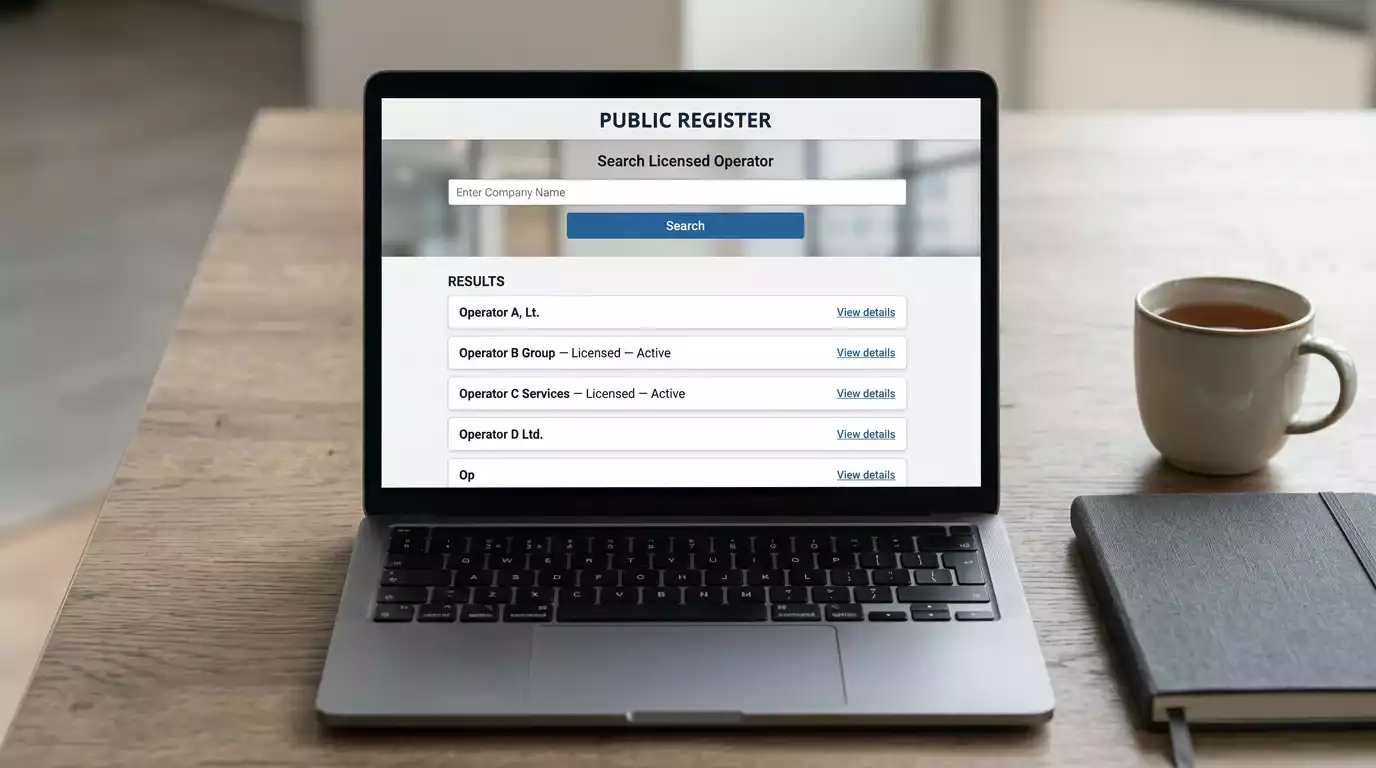
The 60-second check most punters never do
The UKGC runs a public register that lets anyone, for free, verify whether a specific betting operator is licensed to take bets from UK residents. The check takes about a minute. Most British punters have never used it. And given that UK authorities are currently monitoring around 1,000 illegal gambling services actively targeting UK customers, that gap between “can verify” and “do verify” is where a meaningful share of the migration to unlicensed sites begins — not through informed choice but through operators presenting themselves as legitimate when they’re not.
Before you deposit a penny with any racing bookmaker, the UKGC Public Register is the single source of truth. Footer logos, “licensed by” badges, and regulatory statements on the operator’s own website can be fabricated. The register cannot. This piece walks you through what a UKGC licence actually means, how to use the register in practice, the common signs of unlicensed sites, and what to do if you realise you’ve already signed up somewhere that isn’t on the list.
What a UKGC licence actually means
A UK Gambling Commission licence gives an operator the legal right to accept bets from customers in Great Britain. It comes with obligations: adherence to the licensing objectives (keeping crime out of gambling, ensuring gambling is fair and open, protecting children and vulnerable people), compliance with technical and social responsibility standards, mandatory contribution to the research, prevention and treatment levy, and submission to ongoing Commission oversight including audits, complaint investigations, and enforcement action.
What this gives you as a customer, practically speaking: an operator bound by rules you can enforce. If your balance is frozen unfairly, there’s a documented complaints process. If you feel a bet was settled wrongly, there’s an Alternative Dispute Resolution provider listed on the operator’s site. If the operator goes insolvent, there are requirements around segregation of customer funds (though the specific protection level varies by licence class). Every one of these mechanisms depends on the operator actually holding a UKGC licence — if they don’t, the mechanisms don’t exist.
What a UKGC licence doesn’t guarantee: that the operator is good. Plenty of UKGC-licensed firms offer poor customer service, restrict winning accounts aggressively, or apply affordability checks in ways punters find frustrating. The licence is a floor, not a ceiling. It means the operator is legally permitted to trade and subject to regulatory oversight; it doesn’t mean every commercial or customer-service decision they take is ideal. For the standards of trading itself — odds, promotions, withdrawal speeds — you still need to assess operators on their commercial merits. The licence check just confirms the operator is operating within the legal framework where those commercial assessments apply.
The structural context: as of March 2025 there were 3,086 licensed gambling operators in Great Britain, a 2.3 per cent decrease on the prior year. That’s a shrinking regulated market, which makes the unregulated competitive environment all the more active for the operators who lose their licences or never held one.
Using the public register
The UKGC Public Register lives on the Commission’s own website. You search by operator name, by trading name, or by licence number. Results show the legal entity holding the licence, the trading names associated with it, the licence classes held (remote betting, non-remote betting, software, etc.), the current status (active, suspended, surrendered), and the date of last licence action.
In practice, most punters should search by the brand name they’re considering. A search for the brand you’re assessing should return an active UKGC licence with the trading name matching — or, more commonly, should show that the brand is a trading name of a parent company licensed under a different name. “Coral” is a trading name of Ladbrokes Coral Gaming Limited; “Paddy Power” is a trading name of PPB Entertainment Limited. The parent entity and the brand don’t have to match exactly, but the register must link them.
Signs that warrant further investigation: a brand name returning no results at all, a brand linked to a parent whose licence status is “suspended” or “revoked”, or a search returning a similar-but-not-identical brand name that turns out to be a different operator. Common scam patterns include setting up sites with brand names very close to licensed operators’ names, hoping customers don’t notice the misspelling. A one-letter difference in the brand name is enough to separate a licensed operator from an imitator; the register is the mechanism that catches the difference.
One nuance: the register shows the licensee, not individual websites. A licensed operator can have multiple URLs, including regional or promotion-specific domains. Don’t assume a site at a URL different from the main brand’s primary domain is unlicensed — but do verify that the domain’s operator is the licensed entity by checking the site’s terms-and-conditions page, which will state the operating company and licence number.
Common signs of unlicensed sites
A few patterns recur in unlicensed operators targeting UK customers. The first is offering extravagant welcome bonuses — matched deposits of 200 per cent or more, hundreds of pounds in free bets for £10 deposits. UKGC-licensed operators are bound by advertising rules that limit how bonuses can be presented, and the maths of regulated promotions rarely permits the kind of offers unlicensed sites advertise. If the welcome offer feels too generous by comparison to the licensed market, it probably is.
Second: instant onboarding with no identity verification. A licensed UK bookmaker is required to verify your identity before allowing your first withdrawal, and most require at least partial verification before your first deposit. An operator that lets you deposit, bet, and withdraw within hours without ever asking for ID is operating outside the framework, and the absence of KYC friction is the easiest structural signal you’ll see.
Third: payment methods that don’t match UK licensed operators’ standard suite. UK-licensed firms typically offer debit card, bank transfer, PayPal, and a limited range of well-known e-wallets. Unlicensed operators often push crypto-only deposits, obscure prepaid cards, or intermediary payment processors based in jurisdictions without clear consumer protection. Payment structure is one of the first things regulatory authorities scrutinise, and unlicensed operators typically route customer funds through channels that wouldn’t pass a UKGC audit.
Fourth: regulatory statements citing licences from jurisdictions that don’t have UK recognition. Curaçao, Kahnawake, Anjouan — these are real gambling licensing jurisdictions, but none of them permits an operator to legally take bets from UK residents. An operator displaying only a Curaçao licence and accepting GBP deposits from UK postcodes is, by definition, operating without UK authorisation regardless of what other licence they hold. The BGC’s Frontier Economics-commissioned study put annual black market betting handle in the UK at up to £4.3 billion, and the operators generating that activity typically display offshore licences as pseudo-legitimacy rather than UK ones.
Fifth: customer reviews or forum discussion highlighting balance freezes, inexplicable account closures, or withdrawal refusals without complaint channels. UKGC-licensed firms have their customer complaints subject to ADR processes and ultimately to Commission review; the patterns of unresolved complaints at specific operators are a strong indicator of regulatory status. If the complaint pattern on a site looks like customers have no route to resolution, the site probably isn’t licensed.
What to do if you’re already signed up
Check the operator against the UKGC register immediately. If they’re licensed, your existing account is covered by UK consumer protections — any issues you’ve had should go through the operator’s complaints process and then, if unresolved, through the ADR provider listed on the operator’s site.
If the operator isn’t listed on the register — or is listed but with a suspended or revoked status — the situation is different. Your balance with an unlicensed operator has no UK regulatory protection. Your priority should be initiating a withdrawal of the full balance, because if the operator subsequently becomes insolvent or has its accounts frozen by enforcement action, your funds sit in an unregulated pool. Document everything: account statements, correspondence, withdrawal requests. If the withdrawal is refused or unreasonably delayed, UK banking fraud processes can sometimes recover funds paid by debit card in the preceding 120 days, but this isn’t guaranteed.
Do not deposit further funds while you’re verifying an operator’s status. If there’s doubt about the licence position, that doubt should translate into pausing deposits, not accepting the operator’s word. The UKGC register is the arbiter — not the operator’s own marketing materials.
Finally: if you’ve discovered an operator targeting UK customers without a UK licence, the UKGC accepts public reports of such operators through its website. Reporting doesn’t recover your funds, but it contributes to the enforcement caseload the Commission works through, and public reports are one of the inputs that help the £26 million in additional Treasury funding — allocated specifically for black-market enforcement — translate into action against specific unlicensed operators.
For the wider picture on choosing a UK racing bookmaker beyond the initial licence check, including commercial factors like pricing, withdrawal speed, and promotions, our guide to choosing a UK horse racing bookmaker covers the full selection framework.
Is a Gibraltar licence valid for UK players?
Not on its own. Gibraltar has its own gambling regulator and licenses operators serving various markets, but a Gibraltar licence alone doesn’t permit an operator to take bets from UK residents. The relevant question is whether the operator also holds a UKGC licence — many established UK operators hold both (UKGC for UK customers, Gibraltar for other jurisdictions). Check the UKGC Public Register for the UK position specifically.
Does the UKGC register include affiliates?
No. Affiliate websites — sites that promote licensed operators but don’t themselves take bets — aren’t part of the gambling licensing regime and don’t appear on the Public Register. An affiliate’s legitimacy is separate from licensing: they’re advertising publishers, not operators. When you follow an affiliate link to a betting site, verify the destination operator on the UKGC register, regardless of what the affiliate site claims about their partner relationships.
Published by the Betting for Horse Racing team.