Yankee, Trixie and Patent: UK Permutation Bets Without the Singles
 Available in US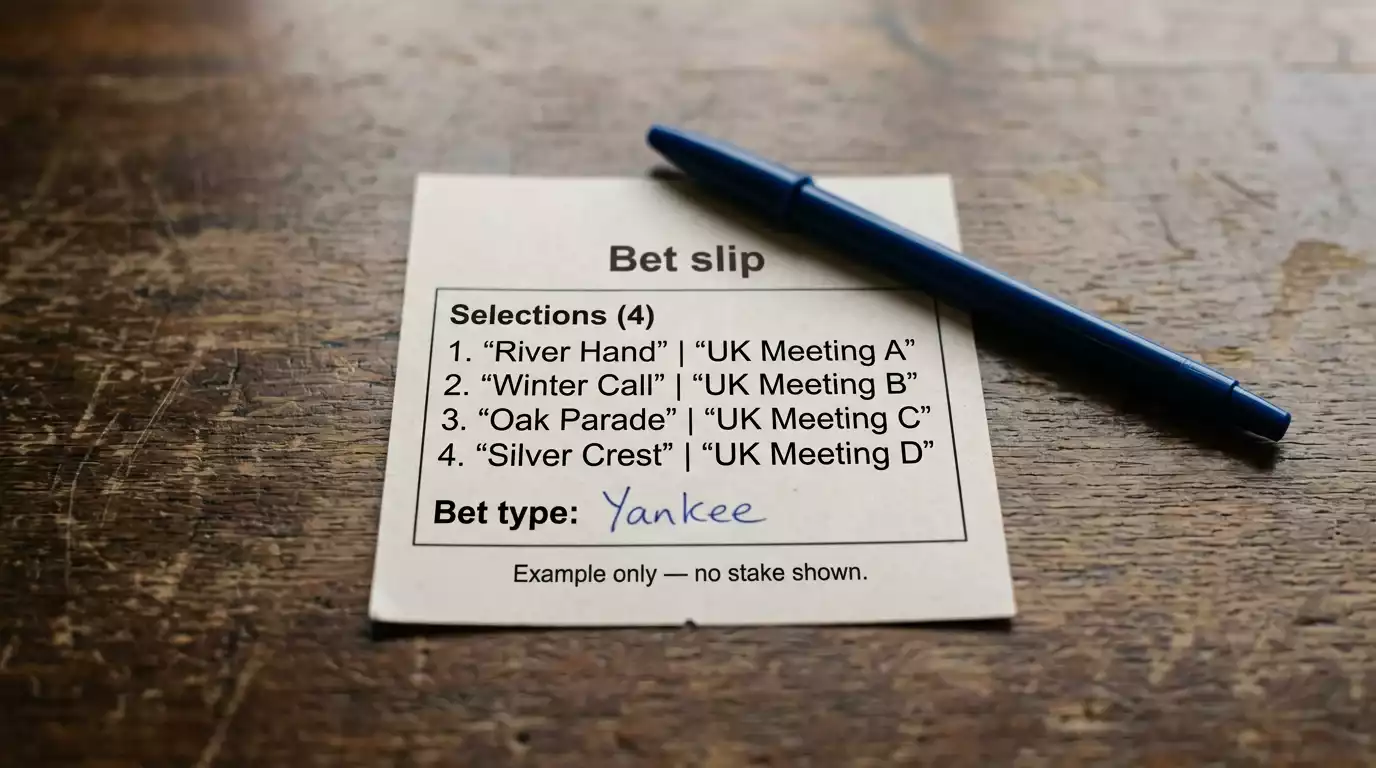
One selection separates Trixie from Patent – and that is not trivia
A punter once asked me why his three-horse slip won when only the longshot came in, while his mate’s identical three horses on a different bet type lost. Same races, same horses, same stake – different outcomes. The slips looked almost the same. The structure wasn’t. One was a Trixie, one was a Patent, and the only difference between them is whether the singles are included. That one structural choice is worth understanding before you stake.
This whole family of bets – Trixie, Patent, Yankee, Super Yankee, Canadian – shares the same grammar. You pick three, four or five selections, and the bet type dictates which multiples you stake. The decisions are mechanical, not mystical, and once you can see the shape of each bet, picking between them becomes a question of selection quality rather than branding. Unlike Lucky bets, these versions don’t carry bonus structures, which in a way makes them cleaner – what you bet is what settles, without the promotional layer hiding the edge.
Trixie with three selections
A Trixie is four bets from three selections: three doubles and one treble. No singles. A £1 Trixie costs £4. Two of your three must win before any return arrives – because one winner alone lands only a single, and there are no singles on a Trixie.
This is the bet’s defining feature. You are staking on combinations, not on individual horses. If you have three picks and you’re confident two will win but unsure which two, Trixie is mathematically the right tool – you don’t care about rewarding single wins, you care about compounding pairs. The £1 stake gets spread across four multiple bets rather than diluted with singles that might lapse anyway.
Where the Trixie is right: three horses at decent prices at different meetings where you genuinely think two or three will win. Where it is wrong: three horses where you’re really only confident on two, because then a single miss on the wrong horse kills all four bets. I use Trixies sparingly, almost always on Saturday cards with three genuinely strong fancies, never as a default “let’s combine these three” cover.
Patent adds the singles back in
A Patent is a Trixie plus the three singles – seven bets from three selections. A £1 Patent costs £7. One winner returns something. Two winners triggers two singles and a double. Three winners triggers all seven bets. The structure is more forgiving than a Trixie because one correct selection, at a high enough price, can make the slip profitable on its own.
The price threshold for the singles to carry the bet is calculable. A £1 Patent needs a single winning at roughly 6/1 to cover the £7 stake when the other two horses lose. At 7/1 you’re level. At 10/1 the single winner returns £11 profit against the stake. Below 6/1, one winner is not enough – you need at least one more leg landing.
Patent suits a selection pattern where you’ve got one genuine longshot you think is live and two supporting picks. The longshot’s single covers the downside; the doubles and treble give you upside if your supporting picks add value. A Patent over three short-priced favourites is, mathematically, roughly the same shape as three singles plus a Trixie you’d probably not have bet independently – make sure that’s the exposure you actually want.
Yankee with four selections
A Yankee scales the Trixie structure to four: six doubles, four trebles, one four-fold. Eleven bets. A £1 Yankee costs £11. No singles. Two winners is the minimum for any return, and the return from two winners is a single double – small in most cases, meaningful only if the two winners are both priced long.
The arithmetic that matters with a Yankee: of your eleven bets, only one is the four-fold, which is the bet paying the big number when everything wins. The other ten are building blocks of that four-fold. The total stake of £11 per unit means a £2 Yankee is £22, a £5 Yankee is £55, and I’ve watched punters drift into Yankees without clocking how quickly the total climbs. At £10 per unit you’re staking £110 on eleven bets, and if only two land at short prices you might claw back £25. The bet is not benign just because each line is £10.
Where Yankees earn their keep is in portfolios of four genuinely well-researched selections across different meetings, where you’re willing to accept that you won’t get any return on a single winner but you’re confident at least two will land. Two correct out of four at mid-range prices – say 7/2 and 5/1 – gives you a double returning £4.50 × 6 = £27 on a £1 Yankee, profit of £16. Acceptable. Three correct starts returning proper money. Four correct at the prices quoted is a life-affecting slip. Every punter has a Yankee slip story; most of them involve the bet that got away by one winner, which tells you about the bet’s variance profile.
Super Yankee and Canadian for five selections
Super Yankee – sometimes called a Canadian in UK slips – is the five-selection version. Ten doubles, ten trebles, five four-folds and one five-fold. Twenty-six bets. A £1 Super Yankee costs £26. Still no singles.
At five selections the combinatorial nature really starts to bite. A £1 stake unit feels small; twenty-six bets collectively do not. I’ve seen first-time Super Yankee backers misread the stake, put £2 per line, and only then realise the slip totalled £52. If you’re going to play Super Yankee, calculate the total before you commit the slip – not after. The upside is genuinely significant when four or five of your five selections land. The downside is that you need at least two winners just to see anything come back, and two winners at average prices will not cover a £26 stake.
Richard Wayman at the British Horseracing Authority put his finger on the broader context in a spring 2025 blog when he said, “Total betting turnover has fallen by nine per cent compared with the same period in 2024. Whilst there is work to be done on the racing product to grow its appeal as a betting medium, there would be a much wider range of factors contributing to this concerning decline.” The practical takeaway for anyone building big-ticket permutation bets: a shrinking market means books are running tighter, margins are thinner to defend, and the path from eleven or twenty-six correlated bets to a profit is narrower than it was three years ago. Not impossible. Just more demanding.
Stake management and what these bets do to your bankroll
The hidden risk with permutation bets is unit creep. Someone who’d comfortably stake £20 on a single tells themselves £2 per line on a Yankee is “small”, then places ten Yankees in a month and has staked £220 on permutations without any of the single-bet consideration. The total outlay is what matters, not the per-unit figure.
My working rule: the total stake on any permutation bet should be within the single-bet ceiling I’d accept for that day’s card. If my normal maximum single is £20, a Yankee stake unit should be under £2. A Super Yankee unit should be under £1. I bend the rule for festival days with real conviction on multiple horses, but not by much, and never with stake units that feel “small” in isolation rather than by the slip total.
The other piece of stake discipline specific to these bets: don’t combine them with large Lucky bets on overlapping cards. Watching someone put a Lucky 15 on four horses and a Yankee on three of those same four within twenty minutes is a regular Saturday sight, and it represents a stake profile roughly doubling the intended exposure without doubling the research. Permutation bets reward decisive selection, not diversified coverage.
For context on how these four-and-five-horse bets fit alongside the rest of the UK market – win-only, each-way, forecast and tricast – our UK horse racing bet types guide lays out the full spread of options side by side.
When is Patent better than Trixie?
Patent beats Trixie when you have one selection you rate as a serious longshot at a price high enough that a single winner covers the extra £3 of stake on its own. As a rule of thumb, if any of your three selections is priced at 6/1 or bigger and you think it has a genuine chance, Patent carries more usable protection than Trixie.
How much does a £1 Yankee cost?
A £1 Yankee costs £11, because it combines four selections into eleven individual bets – six doubles, four trebles and one four-fold. Raise the unit stake to £2 and the total becomes £22, to £5 and it becomes £55. Always multiply the per-line stake by eleven before confirming the slip, otherwise the total will surprise you.
Do I need any singles for these bets to pay out?
Trixies, Yankees and Super Yankees need at least two winners out of your selections for any return, because none of them include singles. Patent is the exception in the family – with singles included, one winner can pay out, and at a long enough price a single winner can even leave the slip in profit.
Published by the Betting for Horse Racing team.