UK Horse Racing Bet Types: Every Market Explained for 2026 Punters
 Available in US
Table of Contents
- Why a list of bet types is useless without context
- Win-only bets: the purest market in British racing
- Each-way bets: two halves that rarely get equal thought
- Place-only bets: the underrated sibling
- Forecasts and tricasts: putting finishing order on the line
- Accumulators and multiples: compounding confidence
- System bets: Lucky 15, Yankee, Trixie and friends
- Ante-post versus day-of-race: the time-versus-certainty trade-off
- Tote pool bets: the other way of backing a horse
- Rule 4, dead heats and the deductions nobody reads about
Why a list of bet types is useless without context
The first proper argument I ever had with a friend about racing was in a Newmarket pub, over whether each-way on a 14-runner handicap was a mug bet or a value bet. Neither of us changed our mind that night. What I know now, after nine years of tracking British racing markets for a living, is that the answer wasn’t “yes” or “no” — it was “depends on the race, the runners and what the bookmaker is paying on the place”. That’s the whole problem with lists of bet types. They treat a win-only, an each-way, a Lucky 15 and a Tote placepot as if each one has a fixed character. It doesn’t work that way.
In British racing, your bet type is a tool — and like any tool, it’s only as good as the decision to pick it up. A win-only is ruthless on a 5-runner conditions race and reckless on a 22-runner cavalry charge at Ayr. An each-way is a tax on your stake when the field is short, and a quiet goldmine when a bookmaker offers four places on a 16-plus-runner handicap, because that’s the industry standard for big-field heats. Forecasts, tricasts, ante-post markets and the Tote each have their own version of this same rule.
So this is not a glossary. Every bet type below gets the same three-part treatment: how it actually works, the moment it makes sense, and the moment it quietly eats your bankroll. If you want the broader picture of how odds, festivals, regulation and bookmaker choice sit together, my complete 2026 UK racing betting guide pulls the whole ecosystem into one read. This piece is narrower and, I hope, more useful the next time you’re standing at a screen with forty-five seconds to the off.
Win-only bets: the purest market in British racing
A gent I used to share a form book with in Lambourn called the win-only “honest money”. I’ve always liked that phrase. You back a horse, it crosses the line first, you get paid; everything else is noise. No partial returns, no deductions for second-place moral victories, no clever mathematics. If the horse loses by a short head, your slip is scrap paper.
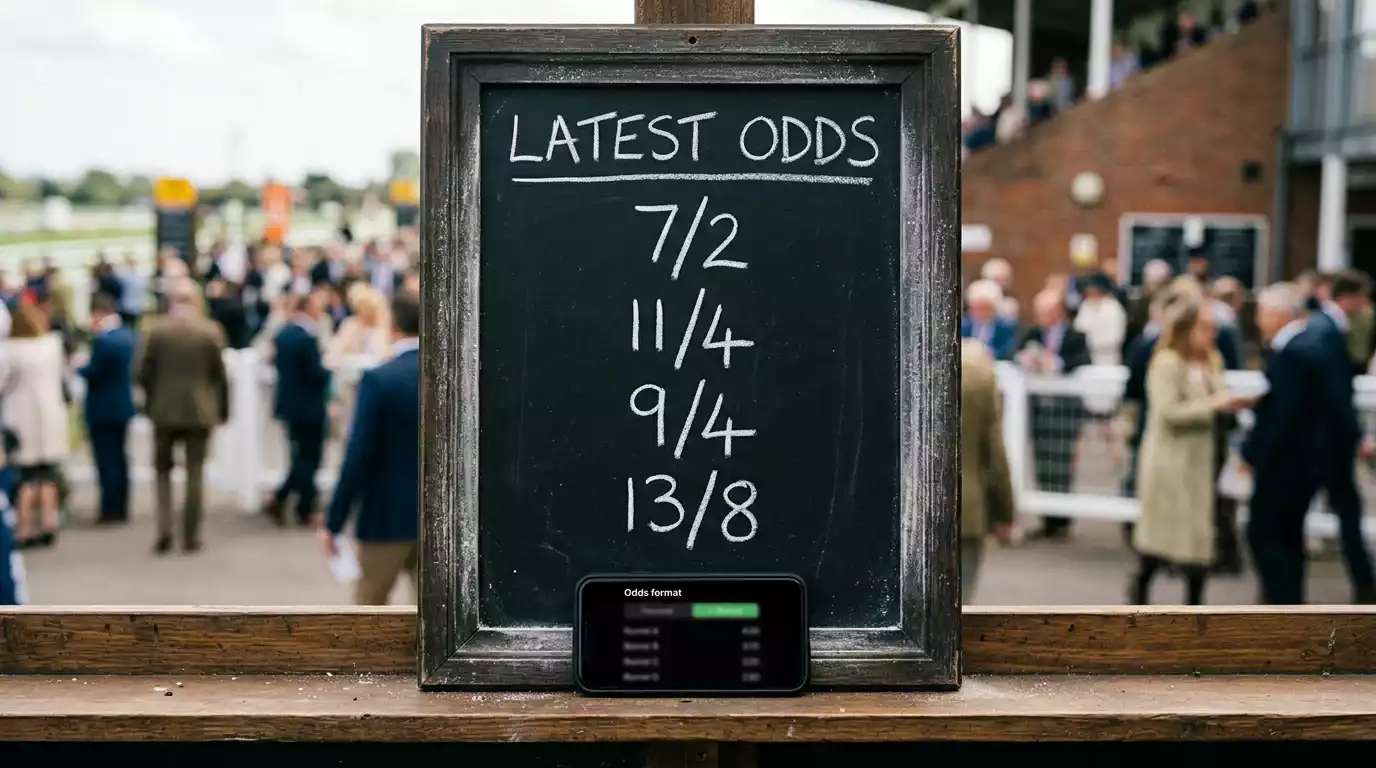
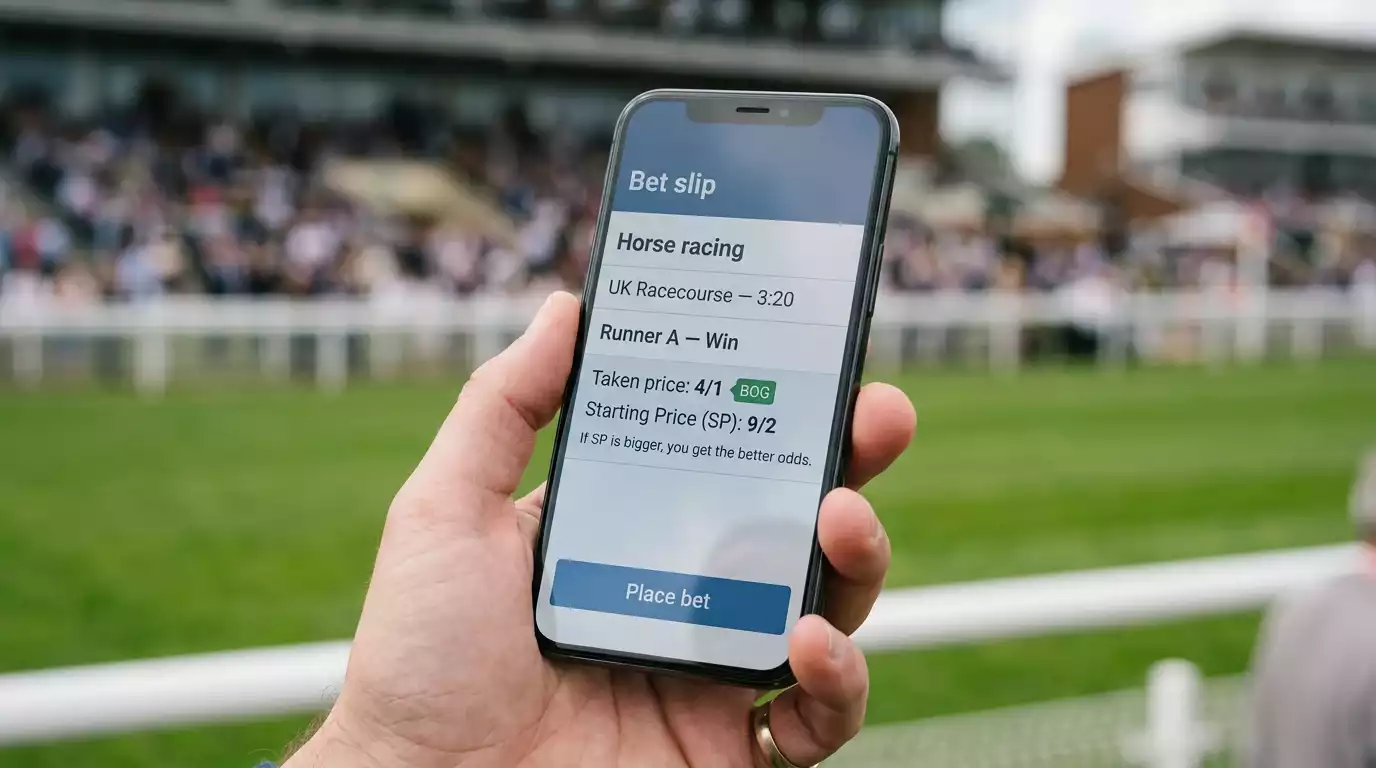
That’s the appeal and the punishment in one package. The win market is the cleanest read on a bookmaker’s confidence in every runner, because it isn’t inflated by place-pool calculations or each-way arithmetic. When you see 3/1 next to a name, the layer is saying — in old-fashioned fractional odds still dominant on British boards — that for every £1 you stake, you’ll take £3 profit plus your stake back if the horse wins. A £10 bet at 3/1 returns £40. A £10 bet at 11/8 returns £23.75. Nothing more, nothing less.
Where win-only comes into its own is in small fields and in races where the favourite is short enough that each-way dilution hurts more than it helps. Five runners, six runners, seven runners — the bookmaker pays each-way on only the first two places, and at a quarter of the odds. Splitting your stake across two halves at those terms is usually a worse expected return than staking the full amount on a win. Short-price favourites make this worse still. If your horse is 11/8, the place part of an each-way bet is priced at fractional odds so meagre that winning the place alone rarely recovers your combined stake.
I use win-only in three situations: conditions races with six or fewer runners, any race where my fancy is odds-on, and any race where I’m specifically playing for a price I think is too big rather than for a safety net. The rest of the time, I’m at least considering whether the each-way terms on offer change the maths — which brings us to the next market.
Each-way bets: two halves that rarely get equal thought
Every time someone tells me they “always go each-way to be safe”, I ask them what the place fraction was on their last bet. About half the time they don’t know. That’s the entire problem with how this market is used in Britain — it’s a reflex, not a decision.
Here’s the mechanic, because getting it right matters. An each-way bet is two bets stitched together: one half on the horse to win, the other half on the horse to place. Your total stake doubles. If you ask for £10 each-way, you hand over £20. The win half pays at the full listed odds if the horse wins; the place half pays at a fraction of those odds — usually a quarter or a fifth — if the horse finishes inside the paid places.
The paid places are the entire point. UK industry practice sets a standard scale: in races with eight or more runners, bookmakers typically pay three places on an each-way bet; in handicaps with 16 or more runners, they pay four. Anything shorter than eight runners and you’re down to two places. Those tiers matter because each-way stops being value the moment the number of paid places stops growing but the place fraction stays the same. A 14-runner handicap paying three places at a quarter of the odds is a very different animal from a 22-runner Ayr sprint paying five or six places at a fifth of the odds during a big-festival offer.
Worked example, because abstractions are useless here. You back a 14/1 shot each-way at £5 each-way in a 12-runner race paying three places at 1/4 odds. Total stake: £10. If the horse wins, the win part pays £5 × 14 = £70 profit, the place part pays £5 × (14/4) = £17.50 profit, plus both stakes back. Total return: £102.50 from £10. If the horse only places, you lose the £5 win part but collect £17.50 profit plus £5 stake back on the place. Total return: £22.50 from £10 — a £12.50 profit on a placed bet.
That’s the case for each-way. Now the case against. Short-priced favourites make the place fraction nearly worthless. A 5/2 favourite each-way in an 8-runner race hands the place bet at 5/8, which rounds down to you risking your second £5 to win £3.12 profit. Fold in the fact that the bookmaker’s margin sits in that place fraction, and you understand why sharp punters tend to back outsiders each-way and shorter fancies win-only. The rough working rule I use: at odds of 4/1 or longer in fields of 8-plus, each-way is worth weighing; at odds shorter than 3/1 in fields under 10, I almost never bother.
Place-only bets: the underrated sibling
Here’s a question that will tell you a lot about how well you understand each-way. Why, if you only care about your horse finishing in the places, would you ever bother paying for the win half of the bet as well? Most British punters never ask. Place-only bets are the quiet answer to that question, and they’re one of the least-discussed markets in UK racing.
A place-only bet is exactly what it sounds like. You stake on a horse to finish inside the paid places — two, three, four, however many the race is paying — and nothing else. No win payout if it takes the prize. No split stake. One bet, one outcome. The odds are shorter than the win price, obviously, because you’re getting paid on more outcomes. But the trade-off is direct: you keep your full stake on the one part of the bet you actually want.
Not every online bookmaker prices place-only markets on every race. The traditional home of place-only is on-course and in the Tote pool, though several UK sportsbooks now offer fixed-odds place-only on feature races, especially Saturdays and festivals. The prices you’ll see are calculated from the implied win probability and the number of paid places, with the usual bookmaker margin baked in.
When does place-only beat each-way? Roughly, whenever you’d be happy to lose the win half of an each-way bet. If you fancy a horse at 12/1 to run well and grab a frame but you don’t genuinely think it’ll beat a strong favourite, you’re better off putting your whole stake on the place market rather than paying for a win outcome you don’t really expect. The maths almost always favours it. The catch is discipline — you’re giving up the dream scenario. That’s not always easy, but betting rarely is.
Forecasts and tricasts: putting finishing order on the line
A tricast on the Lincoln once paid me £847.60 off a £2 stake. The same month, I lost seven tricast bets in a row without so much as a sniff of a payout. Both facts are true, and both tell you what you need to know about this bet type before you ever put it on a slip.
A forecast is a bet on the first two horses in a race in the correct finishing order. A tricast is the same idea with three horses in the correct order. Both are computed markets — the winning price is calculated after the race by a formula applied to the starting prices of the horses involved, rather than being fixed in advance. The more horses in the race and the longer their prices, the bigger the dividend.
The key variations worth knowing: a straight forecast is fixed order, 1st–2nd as named. A reverse forecast covers both orders — you’re effectively placing two bets, so the stake doubles. A combination or permutation bet expands that further: a three-horse combination forecast covers all six possible ordered pairs between your picks, so a £1 combination is a £6 outlay. Tricasts follow the same logic; a three-horse combination tricast is six lines, a four-horse combination tricast is 24 lines. This is where stakes get away from people.
When do forecasts pay? When you have a strong view on a second horse that the market doesn’t rate as highly as the favourite, or when you think two specific outsiders are both likely to beat a fashionable front-runner. On handicaps with 14-plus runners, the computed tricast dividend on three outsiders can turn a £1 combination bet into a four-figure return. That’s the upside. The downside is obvious: you’re trying to predict a very specific outcome in races that reliably deliver finishes the form book never saw coming.
My working rule is simple. I don’t do straight forecasts on fancied horses — the computed price barely beats the implied odds of two separate win bets. I save tricasts for races where I have a genuine opinion on at least two mid-priced outsiders and where the favourite looks beatable. And I never — genuinely never — put a combination tricast on a race I don’t understand, because the line count adds up faster than your conviction does.
Accumulators and multiples: compounding confidence
Accumulators are the marketing dream of every bookmaker, which should tell you something before you read another word. A six-fold Saturday acca for £10 with the potential to return £4,000 is the kind of bet that looks irresistible in a television advert and, statistically speaking, loses 19 times out of 20.
The mechanic is straightforward enough. An accumulator is a single bet that combines two or more selections into one line, where the returns from each winning leg roll onto the next. A two-horse double multiplies the odds of the two; a treble does the same with three; a four-fold with four, and so on up to whatever the bookmaker’s limit is — usually ten or twelve selections. If every leg wins, you collect big. If any single leg loses, the whole bet is dead.
Here is where the mathematics gets brutal. If each of your selections has a genuine 50% chance of winning, a four-fold’s chance is 0.5 × 0.5 × 0.5 × 0.5 = 6.25%. Accumulators magnify confidence, not value — the bookmaker’s margin compounds with every leg. A five-percent margin per race is tolerable as a single bet but becomes a 23% effective overround on a five-fold.
So when does an accumulator make sense? When your individual legs are genuinely long-priced selections you’d have backed anyway, and you’re using the acca as a low-stake way to capture correlated upside. If I’m backing four 10/1 outsiders across a Saturday card because I think each of them represents value, combining them as a £2 four-fold gives me a modest-cost punt at a serious dividend, without changing my underlying views on the individual races. That’s different from loading up six short-priced favourites at 4/6, 8/13 and 5/4 because the combined price looks like real money — that route is how people slowly donate to the industry.
A short rule I’ve lived by: if you wouldn’t back every leg as a singles bet on its own merits, don’t include it in the acca. The moment you find yourself picking a fifth leg because “I needed a sixth to bump the odds up”, you’ve stopped backing horses and started backing a number. The two are not the same thing.
One further subtlety. Some bookmakers offer “acca insurance” refunds if exactly one leg lets you down, typically as a free bet up to a capped amount. These offers are worth factoring in — they reduce the variance of the bet — but they’re also tightly designed to encourage more volume, so read the terms before you rely on them. The refund is usually a free bet with rollover conditions, not cash to your wallet.
System bets: Lucky 15, Yankee, Trixie and friends
A chap in my local bookmakers in Cheltenham tried for years to explain to me, over half-pints of bitter, why the Lucky 15 was “the only sensible Saturday bet”. He was retired, funded his racing from a union pension, and went home happy about a third of the time. I never quite agreed with him on the maths, but I understood the appeal. System bets are how British punters have always combined small hope with small stakes.
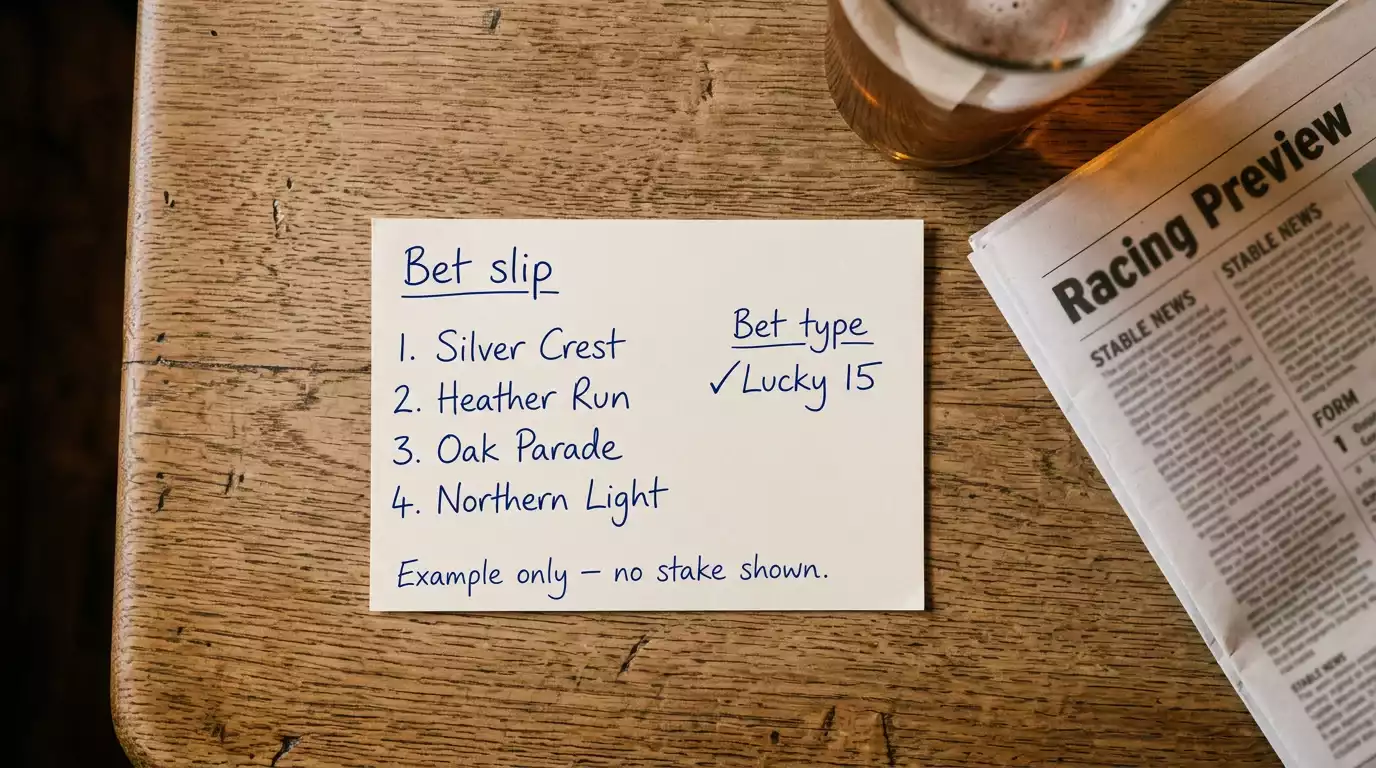
A system bet is a prearranged package of multiple bets on a set of selections, packaged into one slip with a fixed line count and a predictable outlay. The Lucky 15 — the most popular — takes four selections and turns them into 15 separate bets: 4 singles, 6 doubles, 4 trebles and 1 four-fold. A £1 Lucky 15 costs £15. The Lucky 31 does the same across five selections for 31 bets. The Lucky 63 — six selections — gets you 63 bets.
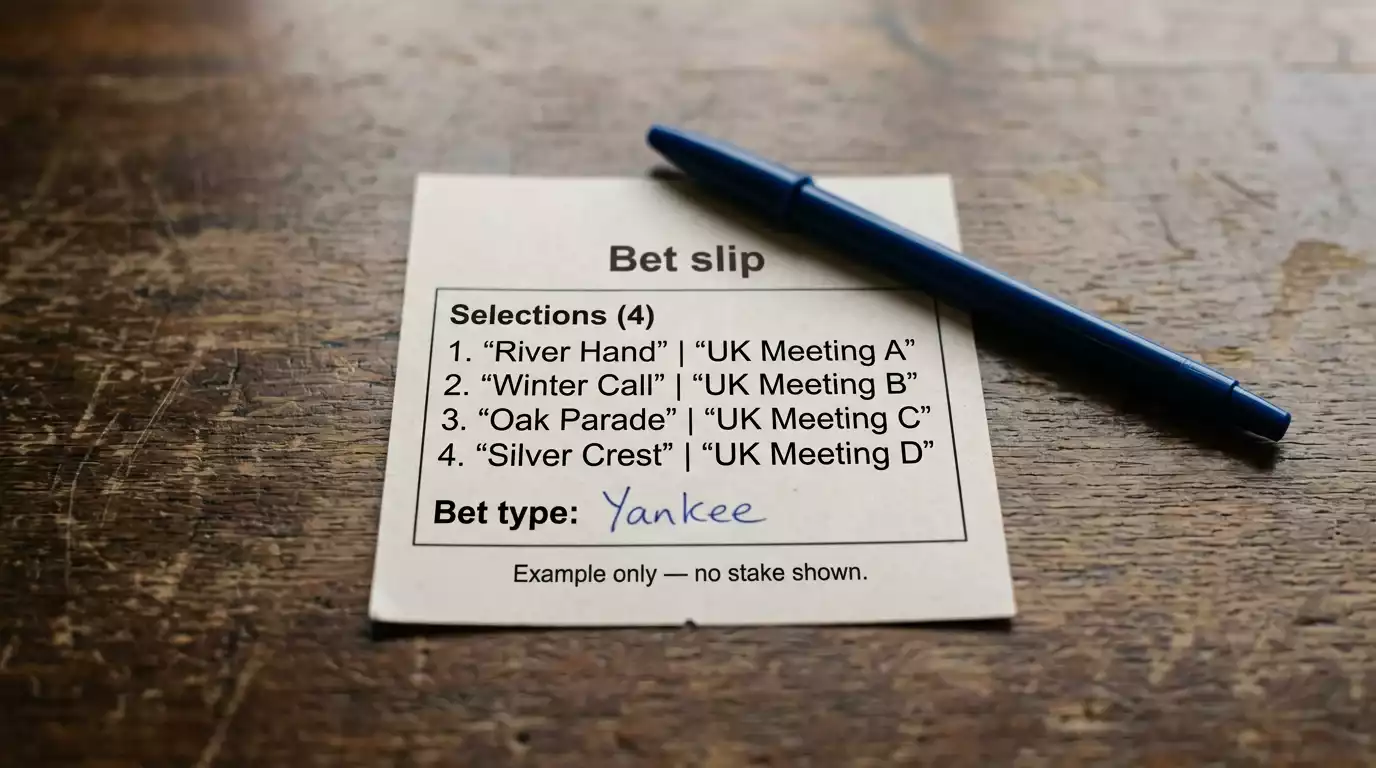
Alongside these “Lucky” bets sit their no-singles cousins. A Yankee is 11 bets across four selections: 6 doubles, 4 trebles and 1 four-fold. A Trixie is 4 bets across three selections: 3 doubles and 1 treble. A Patent is 7 bets: 3 singles, 3 doubles and 1 treble — the three-selection version of a Lucky 15. The Super Yankee or Canadian is a five-selection Yankee variant with 26 bets; the Heinz is a six-selection, 57-bet behemoth; the Super Heinz and Goliath extend the idea to seven and eight selections respectively.
All of these follow the same underlying logic. You spread risk across more outcomes, so one or two losing legs don’t kill the entire bet. In return, you stake more up front and the bookmaker’s margin compounds across more lines. Some bookmakers sweeten system bets with bonuses — double odds on a single winner, a 10% or 20% treble-up for all selections winning — and those bonuses genuinely change the expected return, especially on Lucky 15s.
My honest position on system bets is this: they make sense when you genuinely fancy all of your selections at prices you’d back as singles anyway, and you want a structured package that gives you several ways to profit rather than one. They don’t make sense — and I watch punters do this every weekend — when you pick the four best outsiders across a Saturday card “because a Lucky 15 needs four names”. At that point you’re paying to guess, and the packaging is just a neater way of losing the money.
A short practical note on stakes. Punters frequently underestimate how much a system bet actually costs. A £2 Lucky 15 is £30 out of your pocket, not £2. A £5 Heinz is £285. I’ve seen people walk into bookies for a “small Lucky 15” and genuinely not realise they’ve staked £60 until the cashier reads the slip back. Know the multiplier before you ask for it.
Ante-post versus day-of-race: the time-versus-certainty trade-off
Forty of the strongest stayers in Britain and Ireland line up at Aintree every April for the Grand National, and rough industry estimates place around £250 million of stakes on that single race — including the combined bets of roughly 12 million British adults. A chunk of those bets are placed months before the race, at ante-post prices, and for every one of them the same question applies: is the extra value worth the risk of the horse not running?
Ante-post betting means placing a bet on a race before the final field is confirmed — sometimes weeks or months in advance, particularly for Cheltenham and Aintree feature races, and for the Classics. The attraction is price. A Gold Cup fancy quoted at 12/1 in December might shorten to 6/1 on the morning of the race, and if you’re confident the horse will run and run well, the ante-post price is genuinely a better bet than the day-of-race price.
The catch is the oldest rule in the book: if your horse doesn’t run, your ante-post stake is lost. No refund, no transfer. Injuries, changes in the weather that make the going unsuitable, or simply the trainer deciding to target a different race — any of those and the slip is dead. This is where the industry has evolved. For big-field festival races, many UK bookmakers now run “non-runner no bet” concessions on specific markets during specific windows before the race, which refund stakes on withdrawn horses. Those windows are narrow and vary by operator; you need to read the terms, not the headline.
Day-of-race betting is the opposite trade-off. Prices are generally tighter because the market has digested final declarations, going reports, weighed-in jockeys and morning moves. But your stake is protected against non-runners in the conventional way — if the horse is withdrawn before the off, you get your money back. For most people, most of the time, day-of-race is the right choice. For bigger races where you have a strong opinion on a horse months out, ante-post can be genuinely profitable.
The trap I see repeatedly is ante-post punting on races where the field isn’t even close to being set. Backing a horse at 20/1 for the Derby in November sounds shrewd until you realise twenty other horses haven’t even been entered yet, many of them probably better than your fancy. The closer you get to declarations, the more the ante-post price reflects reality. The further out you go, the more you’re paying a lottery for the right to hold a slip.
Tote pool bets: the other way of backing a horse
Pool betting used to be everywhere on British racecourses. Now it’s a smaller corner of the market — around 5% of total UK betting turnover, with the vast majority still going through fixed-odds bookmakers. But that 5% includes some of the most interesting and under-used bet types in the sport, and if you’ve never tried the Tote you’re missing a legitimate strategic option.
Pool betting is simple in principle. All stakes on a given market go into a single pool. After the race, the pool is divided between the winning tickets, minus a deduction for operating costs. There are no fixed odds — your dividend is determined by how the pool splits and how many tickets share the winnings. The minimum stake for most Tote bets is £2, which matters because it shapes how casual punters engage.
The Tote runs six main bet types: Win (just the winner), Place (to finish in the paid places), Exacta (first and second in order — similar in idea to a forecast), Trifecta (first three in order), Placepot (to pick a placed horse in the first six races of a meeting) and Quadpot (a placed horse in races three to six). The Placepot is where most recreational Tote money goes, because it’s a structured challenge across a full card with a relatively modest entry.
Where pool betting beats fixed-odds is on unfancied winners in low-confidence races. The pool doesn’t “know” which horse is the favourite the way a bookmaker does; the dividend simply reflects where the money was placed. On a messy handicap where the market can’t settle on a favourite, a Tote Win dividend on a 16/1 outsider can genuinely outperform the fixed-odds SP. Where it loses is on short-priced favourites, which often pay less through the Tote than they would at an online sportsbook.
I use the Placepot roughly once a week during the main turf season and almost daily during big festivals. It’s a structured way to play across a whole card without committing large sums to individual races, and the winning dividends on Cheltenham or Royal Ascot Placepot days can be eye-watering. That’s not an argument that the Tote is better than fixed-odds; it’s an argument that it’s a different tool for a different problem.
Rule 4, dead heats and the deductions nobody reads about
I once watched a punter argue with a cashier for twenty minutes about why her £50 winning bet had paid out £37. She wasn’t wrong that the maths looked strange. She was wrong that the maths was wrong. Rule 4 and dead-heat rules are the fine print most bet types gloss over, and misunderstanding them can turn a winning slip into a very bad afternoon.
Rule 4 is a deduction applied when a horse is withdrawn from a race after the final declaration but before the off — in other words, after the market has formed but before the runners leave the stalls or the tape. Because that withdrawn horse was taking a share of the implied probability, the prices of the remaining runners are technically too big, so the bookmaker deducts a fixed amount from winning returns. The deduction sits on a sliding scale tied to the withdrawn horse’s odds. A very short-priced non-runner might trigger an 80p-in-the-pound Rule 4. A long-priced withdrawal might trigger nothing at all.
Dead heats happen when two or more horses cross the line level — photo-finish territory. In dead-heat scenarios, the winning stake is divided by the number of horses tied, and the full odds are paid on only that fraction of the stake. A £20 bet at 5/1 that dead-heats with one other horse pays out as a £10 winning bet at 5/1 (returns £60) plus a £10 losing bet — total return £60 instead of £120. The other half of the stake is lost. This catches people out all the time because the slip still says “winner” on it.
Worth saying plainly: these deductions aren’t a bookmaker trick. They’re long-established racing rules that every UKGC-licensed operator applies the same way. Wider factors are reshaping how the British product is bet on — that’s true at the turnover level, and it’s true at the rules-of-payout level too. Know them before you walk up with a slip you think is worth more than it is.
At what runner count does each-way stop being worthwhile?
The inflection point sits around eight runners at the low end and depends on your horse’s price. In fields of five to seven runners paying only two places, each-way is usually a worse return than staking the full amount to win unless your horse is a genuine outsider. In fields of eight or more paying three places, each-way becomes viable at odds of 4/1 and longer; in 16-plus runner handicaps paying four places, it’s arguably the default choice for mid-priced and outsider selections. The rule I use: short prices in small fields, never each-way; long prices in big fields, almost always.
Is a Lucky 15 actually profitable in the long run?
Not on its own. The Lucky 15’s 15-line structure multiplies the bookmaker’s margin across all combinations, so the expected return without bonuses is materially negative. What changes the sums are the common sweeteners — double odds on a single winner, a treble-up bonus if all four selections win — which can shift the bet into genuinely reasonable territory on selections you would have backed as singles anyway. Without those bonuses, a Lucky 15 is a leisure bet, not a profit strategy.
What exactly happens to my ante-post bet if my horse is withdrawn?
By default, an ante-post stake is lost if the horse doesn’t run, regardless of the reason. That’s been the industry rule for decades. The exception is non-runner no bet concessions that UK bookmakers apply to specific races and specific markets — usually the main feature at Cheltenham, Aintree and the Classics — during a defined window before the race. Inside those windows, withdrawn horses have stakes refunded; outside them, standard ante-post rules apply. Always check the operator’s market-specific terms before placing the bet.
Created by the ”Betting for Horse Racing” editorial team.