Cheltenham Festival Betting: A Four-Day Punter’s Playbook for 2026
 Available in US
Table of Contents
- Why Cheltenham rewards work in a way the National never will
- Four days, 28 races, one analytical framework
- Day one: where the Champion Hurdle sets the tone
- Day two: the Queen Mother Champion Chase and two-mile fury
- Day three: St Patrick’s Thursday and the Stayers’ test
- Day four: Gold Cup day and the whole festival distilled
- Reading the going at Prestbury Park
- Festival accumulators: the one card where acca logic sometimes works
- Ante-post windows: when to lock in and when to wait
Why Cheltenham rewards work in a way the National never will
William Hill projected around £450 million in stakes across the four days of Cheltenham 2026, every one of the festival’s 28 races among the top 31 most-bet races of the year. A spokesperson framed the four days as an unrivalled contest between the bookmakers and the punters, and described the festival as the most bet-on of the year in jumps racing. That framing has stuck with me because it’s the right one. At Cheltenham, the punter versus the book is not an abstraction. It’s a four-day contest over a programme of races where the same horses reappear in similar company year on year, the form is genuinely readable, and the serious punter who does the work can see edges the casual punter can’t.
This is the fundamental difference between Cheltenham and the Grand National. The National, as I wrote in the dedicated piece on that race, is a casino-like event where casual money moves the market and chance plays a disproportionate role in a single four-minute spectacle. The Festival is closer to a form-book examination conducted in public — staying chases, championship hurdles, novice events whose graduates go on to shape jumps racing for years — where the horses who turn up are the best of their generation and the verdict of the race tends to reflect genuine merit.
That doesn’t make Cheltenham easy. It makes it different. Form at this level is a crowded field — every serious punter has access to the same Racing Post, the same Timeform ratings, the same pre-festival analysis — so the edge isn’t in the form alone, it’s in how you weigh ground, pace, preparation and late market moves against the consensus. This piece is my attempt to put four days of that thinking into one place, organised around how the festival actually unfolds. For the broader regulatory context and how Cheltenham sits in the UK betting calendar, the complete 2026 UK racing betting guide has the wider frame. This one stays at Prestbury.
Four days, 28 races, one analytical framework
Twenty-eight races. Four days. One location. And every one of those 28 races — confirmed by William Hill’s 2025 analysis — placed inside the top 31 most-bet races of the entire year in British racing. There is no other festival, flat or jumps, that packages this density of betting activity into a single week.
The structure is designed around championships. Each of the four days has a feature — the Champion Hurdle on Tuesday, the Queen Mother Champion Chase on Wednesday, the Stayers’ Hurdle on Thursday, the Gold Cup on Friday — surrounded by supporting Grade 1, Grade 2 and Grade 3 events, novices’ championships, handicaps and the one flat race on the card. The programme rotates occasionally as the BHA and Jockey Club review race scheduling, but the four championship races are the spine around which the festival is built.
Here’s the analytical framework I use for the festival, which I’ll apply consistently across the day-by-day sections below. First, identify the championship race on each day and read it against the horse’s full season form rather than just the most recent prep run. Second, identify the one or two supporting races where your knowledge of the field outweighs your knowledge of the feature — often this is a novices’ event where stable intelligence matters more than public form. Third, categorise the handicaps by competitiveness: some festival handicaps (particularly the County Hurdle and the Coral Cup) are notorious for producing long-priced winners, and the right posture for those is conservative each-way staking rather than win-only conviction. Fourth, watch the market for late moves on the morning of each race — Cheltenham is one of the only meetings where informed late money is a strong enough signal to update your view on.
The thing to resist is the instinct to bet on all 28 races because the festival is on. You don’t need a bet in every race to feel engaged with the festival. If anything, picking the five or six races where you have a genuine view and staking meaningfully on those produces better returns, and considerably better enjoyment, than spraying stakes across every contest.
Day one: where the Champion Hurdle sets the tone
Tuesday morning at Prestbury Park is the moment the year’s jumps racing has been building toward, and if you haven’t walked through the tunnel to the pre-parade ring on the opening day of the Festival, you haven’t quite understood the scale of this meeting. The first race — the Supreme Novices’ Hurdle — produces the single loudest noise in British sport. Punters pour in for it, bookmakers mark it up bullishly, and the roar when the tape goes up is the festival declaring itself.
The centrepiece of the day is the Champion Hurdle, the two-mile championship for hurdlers, run at 15:30 under the usual programme. The form is usually the most transparent of any Tuesday race — the top hurdlers in Britain and Ireland have generally met in feature hurdles at Aintree, Punchestown or Leopardstown over the preceding winter, and the market tends to settle around a clear favourite. The edge on the Champion Hurdle, when it exists, is usually in a challenger coming off a career-best Christmas run who the market hasn’t fully reassessed — the kind of horse whose form figures have jumped a level in the preceding eight weeks.
The novices’ races on the opening day — the Supreme, the Mares’ Hurdle, the Arkle Chase — reward a different type of analysis. Here the form is thinner by definition, public runs may not tell the whole story, and stable confidence as revealed in pre-festival media comments becomes a real signal. Trainers do talk about their novices in the weeks before the festival in ways they don’t about their championship horses, and reading that carefully is genuinely informative.
The Ultima Handicap Chase and the Close Brothers Novices’ Handicap Chase on Tuesday are the opposite — deep handicaps where the market is broad, the form complicated by weight spreads, and the right approach for most punters is each-way at reasonable odds on a horse whose profile — age, weight carried, distance suited, going preference — aligns with historical winner patterns at the festival. These races reliably produce long-priced winners, and the value in them comes from the structure of the event, not from calling the specific horse.
My working approach for day one: one meaningful stake on the Champion Hurdle if I have a clear conviction view, one each-way stake in each of the two main handicaps, and restrained engagement with the novices unless I’ve followed a specific horse through the season. The remaining races are for watching, not for betting — they’re filler in portfolio terms, and filler bets drain money.
Day two: the Queen Mother Champion Chase and two-mile fury
Wednesday is the day I personally find the most watchable. The Queen Mother Champion Chase at two miles is, at its best, the most technically demanding race in the jumps programme — twelve fences, championship pace, and horses whose jumping at speed over regulation chase obstacles is the best the sport can produce. Watching a two-mile chase at that level is the reason people fall in love with jumps racing. Betting on it is a different matter.
The Champion Chase has, in recent years, been a race dominated by clear favourites. That doesn’t make it a good bet. Short-priced favourites in championship races offer limited value unless you have a specific view the market has missed — which, in races where every analyst has watched every Grade 1 prep run, is rare. The alternative is to watch the race as the entertainment it is, and save meaningful stakes for the supporting card where the form reads differently.
The supporting races on Wednesday include the Coral Cup — a competitive handicap hurdle at around two and a half miles that regularly produces 20/1-plus winners — and the Cross Country Chase, a specialist event on the cross-country course whose form book is effectively a self-contained universe. Horses that run well over the cross-country banks, hedges and water obstacles are genuinely different animals from standard chasers, and the form patterns in that race are easier to read if you’ve taken the time to follow the preceding Cross Country series through the winter.
The Champion Bumper on Wednesday afternoon deserves a specific note. It’s a flat race for unraced or lightly raced horses over two miles and half a furlong, and it’s a market where public form is minimal and the informed money tends to move visibly in the last twenty-four hours. The horses going off at 14/1 the morning of the race who drift to 20/1 aren’t getting longer because of news; they’re getting longer because the market is thinning. The horses who shorten from 10/1 into 6/1 are attracting money, and late market moves in the Bumper are, historically, a meaningful signal.
Wednesday’s structure means my staking pattern is usually lighter on the featured Champion Chase and more aggressive on the Coral Cup and a chosen novices’ race where I’ve developed a view. The festival’s pattern of producing long-priced handicap winners peaks on Wednesday, and if you’re going to have one each-way stake that pays double-digit returns, Wednesday’s card is where it’s historically most likely.
Day three: St Patrick’s Thursday and the Stayers’ test
St Patrick’s Thursday is the Festival’s Irish-leaning day, and the card reflects it. The atmosphere at Prestbury on Thursday, particularly if the Irish-trained runners have had a strong first two days, is that of a meeting that has genuinely tilted west across the Irish Sea. It affects the betting. Irish money comes in on Irish-trained horses, prices on favoured Irish runners shorten harder than the form alone justifies, and the market on outsiders who’ve been talked up in Irish publications moves in ways you’d only notice if you’ve been watching trade press.
The centrepiece of Thursday is the Stayers’ Hurdle, run at three miles and around an eighth. This is the hurdling championship for horses whose stamina exceeds the two-mile Champion Hurdle distance, and it reliably produces quality winners. The form over three-mile hurdles in the preceding season is a strong predictor — horses that have won or run close in the Cleeve Hurdle, the Long Walk Hurdle or comparable three-mile prep races are usually the ones to focus on. Short-priced favourites in the Stayers’ have been the right call more often than not in recent years, but the value, when it exists, is usually in the second or third favourite rather than deep outsiders.
The supporting card on Thursday includes the Ryanair Chase — a two-and-a-half-mile chase that has a reputation for producing horses who were outpaced in two-mile championship company but lack stamina for three miles. It’s a specialist trip, and the horses who win it tend to be genuinely matched to it rather than being Gold Cup hopefuls taking an easier option. Reading the Ryanair means reading the horses whose two-mile chase runs ended with them staying on rather than fading.
The Pertemps Network Final is Thursday’s competitive handicap hurdle. Like the Coral Cup the day before, it regularly produces long-priced winners, and the same each-way staking approach applies. The field is deep, the weights are spread, and the horses who win it tend to be horses rated eight to twelve pounds below the top weight whose form on similar ground is demonstrably solid. Reading the going forecast against individual horses’ preferences is the most useful filter for this race.
Thursday’s Cross Country Chase and the Triumph Hurdle for four-year-olds round out the serious betting card. The Triumph is a juvenile championship where public form is built on two or three hurdles runs — thin by definition — and stable confidence in the weeks before the festival matters more than the form book. That’s where the Racing Post’s tipping columnists earn their money, because they talk to the yards in ways the public form can’t.
Day four: Gold Cup day and the whole festival distilled
Gold Cup day is the festival’s full stop, and if I’ve done any analytical work across the week, Friday is where the clearest read on form and condition pays out. The Gold Cup itself — three miles two furlongs, twenty-two fences, the championship of the staying chase division — has produced some of the most memorable finishes in British sporting history, and the field each year is the best horses in training over that trip.
The Gold Cup is a race where the form is usually transparent. The top stayers in Britain and Ireland will have met through the Christmas period in races like the King George VI Chase, the Savills Chase and the Irish Gold Cup. The horses who turn up at Cheltenham arrive with a season’s worth of visible evidence. The market, accordingly, tends to be efficient — the favourite is usually the right favourite, the second and third favourites are usually the right horses in those positions, and genuine value in the 16/1-plus band is rare.
Where value does appear in the Gold Cup, it tends to be in one of two profiles. First, a horse coming off an excellent mid-season run who faced a known challenge in a prep race and came through it strongly — the kind of horse whose last start looked disappointing on paper but was contextually explicable. Second, a horse whose form is strong but whose connections haven’t publicly committed to the race until late, which can keep the price artificially long while the field firms up. Both of these are rare, and neither is an excuse to bet outsiders simply for the appeal of a long price.
The supporting Gold Cup day programme includes the County Hurdle — the festival’s most notorious competitive handicap hurdle, which has produced some of the longest-priced festival winners on record. The field is deep, the handicapper has had a full season to shape the weights, and the form is spread across horses whose paths haven’t crossed in any coherent way. The right approach to the County Hurdle is exactly the opposite of the Gold Cup: accept that the form is opaque, stake each-way in small amounts on two or three horses whose profile fits festival handicap winners, and treat any winning bet as a bonus rather than an expectation.
The Albert Bartlett Novices’ Hurdle — three miles for novice hurdlers — is Friday’s quality novice race, and it’s often a better bet than the Gold Cup in value terms because the form is less thoroughly digested by the market. Novices who’ve been competing over similar distances through the winter and have shown genuine stamina credentials are the ones to focus on, and the market on these races is less crowded with casual money than on the day’s feature.
The Foxhunter Chase — run over the full Gold Cup course for amateur riders — closes the championship programme. It’s a specialist race whose form patterns don’t translate neatly from professional jumps racing, and unless you’ve been following the hunter-chase circuit through the winter, it’s usually a race to watch rather than bet on.
My working approach to Gold Cup day is focused staking on the Gold Cup itself with modest each-way action on the County Hurdle as the structural bet of the day. The Albert Bartlett is a race I’ll have a view on if I’ve been following the novice staying hurdle scene; if I haven’t, I leave it alone.
Reading the going at Prestbury Park
The going at Prestbury in March is the most commented-on, most analysed and most frequently misread weather variable in British racing. Cheltenham in March can serve up anything from firm ground in a dry spring to genuinely heavy conditions after a week of rain, and the difference between those states reshapes the entire festival’s likely winners.
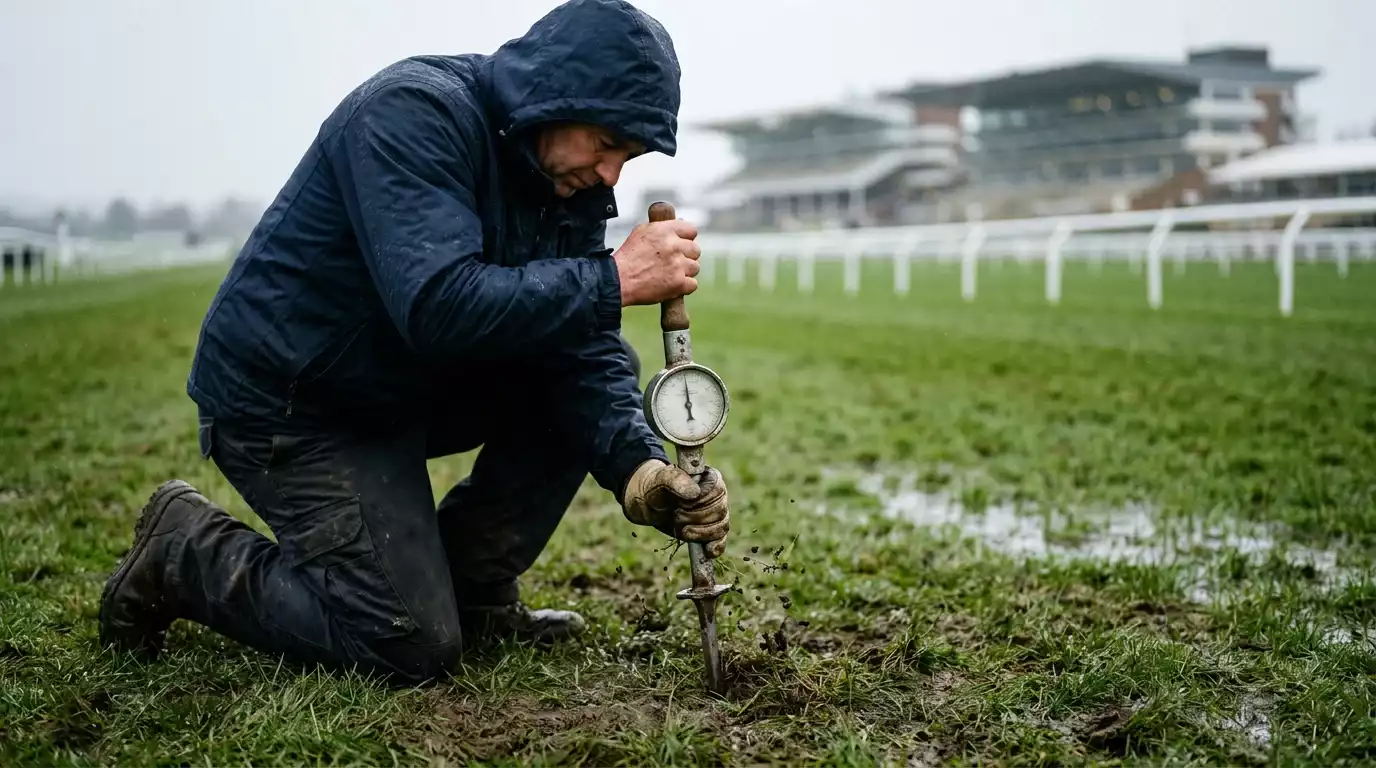
Going is described on a standard UK scale — heavy, soft, good to soft, good, good to firm, firm — with “heavy” the softest and most stamina-sapping, “firm” the driest and fastest. Cheltenham’s course tends to ride a little slower than the going description suggests because of its undulating nature — the uphill finish in particular punishes horses who aren’t comfortable on the described state, which is why a going stick reading that looks benign on paper can still produce a slower race than expected.
What this means for betting is concrete. Horses have measurable going preferences — form patterns accumulated over careers that indicate which state they’re most comfortable on. A horse with form figures that read 1-2-1 on heavy ground and P-P-F on good is telling you something unambiguous. The Racing Post form book carries going-specific form breakdowns, and reading them against the forecast for Festival week is a basic analytical step most casual punters skip.
The going forecast matters because it changes late. A wet Monday before the Festival that dries up by Tuesday morning shifts the ground state between the time you read Friday’s preview and the time the first race runs. The BHA and Jockey Club issue going updates at least twice daily during festival week, and the market reprices around those updates in real time. If the ground shifts from “good to soft” to “soft” overnight before Tuesday’s opener, horses who prefer softer ground firm up in the market and horses who prefer the top of the ground drift out.
The one actionable piece of advice I’d offer: read the going forecast alongside each horse’s going-specific form before you commit to a festival bet, and be prepared to revise your views when the going changes. Punters who’ve done that work have a real advantage over punters who haven’t, because the information is genuinely predictive and the effort required to collect it is modest. For a deeper dive into the going stick and what weather data actually tells you, there’s a dedicated piece on the topic in the wider racing guide.
Festival accumulators: the one card where acca logic sometimes works
I wrote in the dedicated piece on bet types that accumulators are usually the bookmaker’s marketing dream. Festival accumulators are the partial exception. There’s one structural reason they can work at Cheltenham that doesn’t apply to other cards, and it’s worth understanding before you put one on.
In a normal Saturday acca, you’re combining five or six selections across different meetings, different horse populations, different ground conditions and different racing disciplines. The variance is enormous, and the bookmaker’s margin compounds across unrelated events. At Cheltenham, a four-day festival accumulator is combining selections on a single card, in similar conditions, with overlapping horse populations — many horses run multiple times across the four days at different trips — and with analytical views that share common inputs. That creates a degree of correlation between the legs that a standard acca doesn’t have.
Where correlation helps: if you fancy a particular stable’s novices across the festival, a four-fold acca capturing your views on their four main runners is a structurally coherent bet. The stable’s form, preparation quality and jockey choices are common to all four legs. If one of those horses runs well, the others are slightly more likely to run well than a random selection would suggest. The bookmaker’s margin still compounds, but the expected return isn’t as badly degraded as it would be on unrelated legs.
Where festival accas still don’t work: on the championship races taken as a set. Backing the favourites in the Champion Hurdle, Champion Chase, Stayers’ and Gold Cup as a four-fold is a bet most casual punters place, and it’s a bad bet. The cumulative probability of four short-priced favourites winning is low enough that the implied price on the acca rarely beats the expected value of four separate singles. Championship favourites are usually right priced; stacking them doesn’t improve the maths.
The useful festival acca is a conviction bet on two or three specific horses whose form you’ve analysed together, not a lazy acca on the headline favourites. If you genuinely believe a novice from a particular yard is underrated across their two festival engagements, a double capturing both of those runs is a coherent bet. If you’re just clicking the acca builder to get the total odds up, you’re paying a margin tax for no structural edge.
Ante-post windows: when to lock in and when to wait
Cheltenham ante-post markets open earlier than most punters realise — for the four championship races, prices are typically quoted from the autumn onwards, and for the festival handicaps the markets appear in late December or early January as final entries start to narrow. The key analytical windows are different from the Grand National, and it’s worth walking through why.
The Champion Hurdle, Champion Chase, Stayers’ Hurdle and Gold Cup ante-post markets update through the winter as horses contest their prep races. A Gold Cup candidate who wins the King George on Boxing Day shortens materially in the Gold Cup market in the following week; a horse who runs well but finishes second often drifts because the market reads the winner as the stronger horse. Those moves create genuine pricing windows for punters who’ve watched the prep races and formed their own view. If your analytical read differs from the market’s reaction to a specific prep race, the window to act is usually the 48 hours after the prep.
The festival handicaps — the Coral Cup, Pertemps Final, County Hurdle, Ultima Chase — have ante-post markets that open later and price up more conservatively because the handicapper’s weights aren’t published until closer to the race. Ante-post bets on these handicaps carry the usual non-runner risk plus the additional risk that the eventual weight allotted to the horse doesn’t match the price you’ve taken. My working rule is to avoid ante-post bets on the festival handicaps outside the final two weeks before the race, when weights are clearer and fields are firming up.
Non-runner no bet concessions at major UK bookmakers typically apply to Cheltenham feature races during specific windows in the run-up to the festival. The windows vary by operator — some cover the entire Cheltenham week, some specifically target the 48 hours before each day’s racing — and the terms are published on the operator’s dedicated festival pages. Inside those windows, your stake is refunded if the horse doesn’t run; outside them, standard ante-post rules apply.
The trap that catches good punters is ante-post backing in October and November for a March race. Too much can change. Horses pick up injuries, trainers redirect to alternative targets, ground preferences make connections swap into different festival races. Backing in the depths of winter feels shrewd but usually isn’t. The useful ante-post activity is in the final six weeks, when the prep races have produced readable form and the field is close to final. That’s when your analytical work actually pays off.
Which Cheltenham Festival race has the deepest betting liquidity?
The Gold Cup reliably runs the highest turnover of any festival race — it’s the championship race, the culmination of the jumps season, and the single most-bet contest at the meeting. The Champion Hurdle on Tuesday runs second in most years, with the Champion Chase and Stayers’ Hurdle close behind. On a four-day turnover basis, festival totals land around the £450 million mark based on William Hill’s 2026 projection. Liquidity on the main championship races means tighter spreads and better pricing; liquidity on the novice races and handicaps is thinner and the operator margin is generally a little wider.
Is it worth building a festival accumulator or sticking to singles?
For most punters, singles. Festival accumulators work structurally only when the selections are correlated — typically runners from a single yard whose preparation is a common input — and most casual accas combine the headline favourites from four different races, which gives no correlation benefit. The bookmaker’s margin compounds across legs, and the implied price on a four-favourites acca rarely beats the expected return of four singles. If you want one acca, make it a conviction bet on two or three horses you’ve analysed together, not the featured races of each day.
How does soft or heavy going reshape Cheltenham favourites’ chances?
Materially, and more than the market often reflects. Cheltenham’s uphill finish amplifies the effect of soft ground because horses who aren’t comfortable in the conditions fade dramatically in the last three furlongs. The practical check is to read each horse’s going-specific form — the Racing Post breaks form by ground state — and match that against the forecast before committing. A favourite whose best form is on good ground is not automatically beatable on heavy going, but the price should shorten less than the market typically allows on the day the ground is confirmed.
When should I lock in ante-post Cheltenham prices?
The useful window for championship races is typically the final six weeks before the festival, when prep races have produced readable form. Before then, too much can change — injuries, redirected targets, ground-preference swaps. For festival handicaps, ante-post backing carries the additional risk that the handicapper’s weights shift the value. Non-runner no bet concessions from major UK bookmakers apply in defined windows in the run-up to the festival, and those windows vary by operator, so check the specific terms before placing the bet.
Published by the Betting for Horse Racing team.