How Affordability Checks Hit Professional Racing Bettors
 Available in US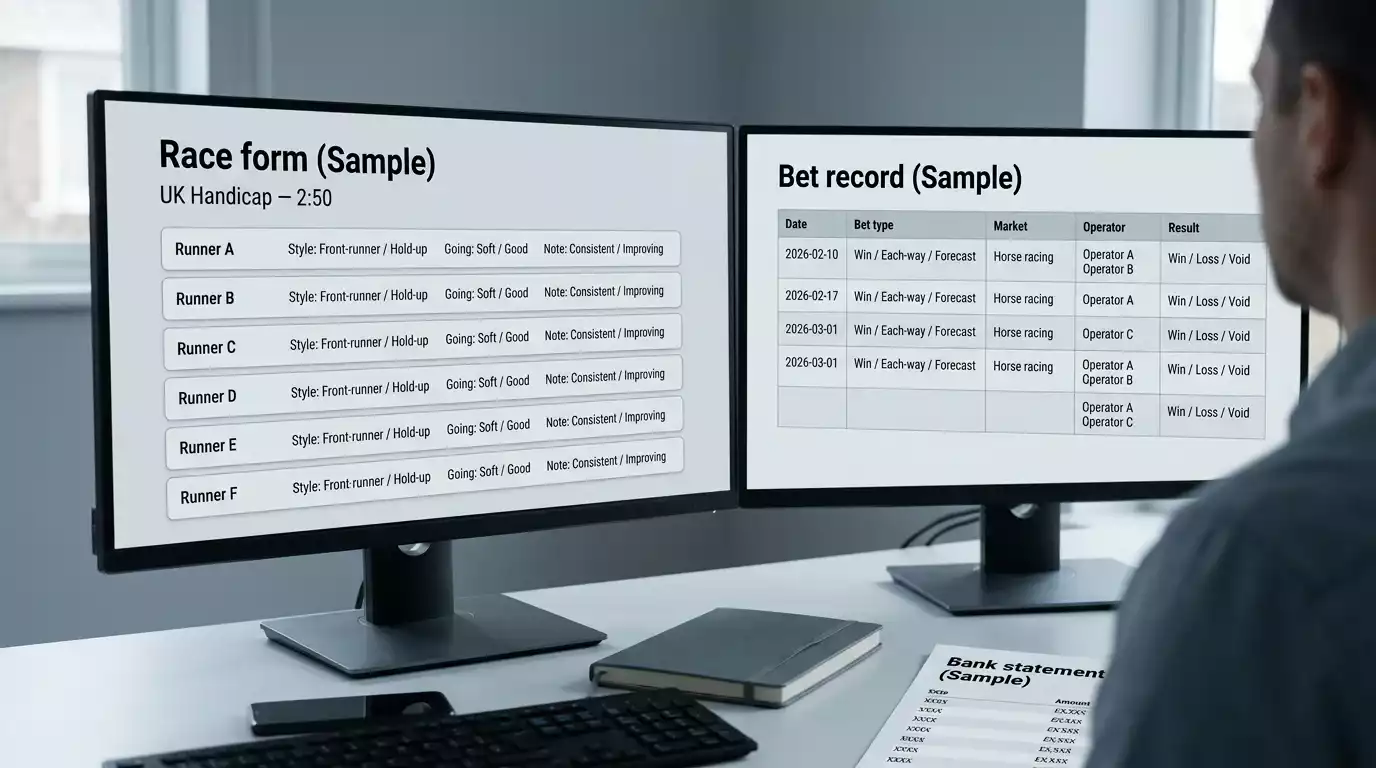
The survey line that tells you everything
One in three UK punters staking £1,000 or more per transaction has used an unregulated site in the last twelve months. That’s the finding from the Racing Post Big Punting Survey 2025, and it is the single most important statistic in this whole conversation. The affordability framework was designed with the recreational punter in mind – the person losing sums they couldn’t afford, chasing stakes they shouldn’t have. It was not designed for the professional bettor, the sharp operator, the person whose staking patterns look large but sit well within an income base built on tax-paid gambling earnings. The professional segment is where the unintended consequences have landed hardest.
This article isn’t a lament. It’s a working map of what changes when affordability checks meet a serious betting operation, the thresholds that bite at the high-stakes end, the documentation burden that comes with regulated staking, and the legitimate alternatives – exchanges, on-course, and others – that professionals routinely use when their licensed-operator accounts become impractical. If you’re staking four-figure sums regularly, this is your shape of the regulatory environment.
Who counts as a professional punter
There’s no UK statutory definition of a “professional gambler”, which is itself a meaningful fact. HMRC doesn’t treat gambling winnings as taxable income, because the UK tax code treats betting as a non-trading activity regardless of stake level or frequency. That’s been settled since Graham v Green in 1925 and hasn’t substantively changed since. A punter making £100,000 a year from racing pays the same income tax on those winnings as a punter making £100 – which is to say, none.
In practice, “professional” in a UK racing context describes a cluster of characteristics rather than a single criterion. Stake sizes regularly at four figures per bet. Annual turnover in the six or seven figures. Bet selection driven by value calculation rather than opinion alone. Multiple bookmaker accounts – five or more is typical, some professionals carry fifteen or twenty – to manage restrictions and price-shop. Record-keeping sufficient to reconstruct every bet and every P&L flow across years. Most professionals I work with sit at the conjunction of these markers rather than at any one.
The segment is small in account numbers but material in turnover share. Professional and semi-professional punters represent a disproportionate slice of total staking at licensed UK bookmakers – exact figures aren’t public, but industry estimates commonly put the sharp segment at under 2 per cent of accounts and 15 to 25 per cent of turnover on competitive markets. When this segment is restricted or migrates offshore, the liquidity impact is much larger than headcount suggests, which is part of why UK betting turnover on racing fell 4.3 per cent in 2025 against 2024 and 10.7 per cent against 2023.
Affordability triggers at high stakes
The standard affordability framework runs on net deposits and net losses. A recreational punter breaching the £500 monthly net deposit threshold triggers a light-touch check. A professional punter depositing £10,000 in a week triggers everything. Every threshold. Every escalation. Simultaneously. And the documentation requested doesn’t scale proportionately – a professional isn’t asked for “bigger” proof of funds than a recreational punter; they’re asked for the same kinds of documents, just more of them, across more categories, with stricter reviewer scrutiny.
The practical reality for high-stakes punters is that enhanced due diligence is the default operating mode, not an exception. Every significant account sees documentary requests within weeks of opening. The scope expands as activity grows. A punter who deposits £25,000 in a month may be asked for three to six months of bank statements across every account showing inflows to the gambling account, source-of-funds declarations covering salary, investments, previous gambling profit, and in some cases a supporting tax calculation or HMRC statement even though gambling income is not declarable.
This last point is where the framework creates friction that doesn’t exist on paper. Professional punters don’t have taxable income from gambling – so an SA302 won’t show the funds flowing through their betting accounts as income. The operator sees this mismatch and escalates further, sometimes all the way to a request for “alternative evidence of funds available for gambling”. The punter now has to produce bank statements showing a standing balance capable of supporting the observed staking, which effectively requires disclosing non-gambling assets to a commercial entity. Many refuse at this stage. The Big Punting Survey 2025 data shows 61 per cent of respondents asked for financial documents refused to provide them – and that number almost certainly skews higher in the professional segment than the average.
Nine years in this role and I see the same pattern monthly: a sharp account runs cleanly for six to eight weeks, an enhanced review lands, the punter refuses on privacy grounds, the account closes, the balance pays out, and the punter opens new accounts elsewhere. This cycle is the modal professional experience in UK racing betting in 2026.
Documentation for tax-paying punters
The mismatch between UK tax treatment of gambling and UK regulatory treatment of gambling creates a documentary trap professionals should understand before it bites. Gambling winnings are not taxable, so there’s no income tax filing trail. Gambling losses are not deductible, so there’s no accounting trail on the downside either. A professional punter whose primary income is gambling has no HMRC document that describes what they do for a living – their self-assessment typically shows minimal other income, a passive investment return here or there, and nothing to corroborate a four- or five-figure weekly betting activity pattern.
What to keep, to make affordability reviews less painful when they come. First, a comprehensive log of betting activity across every operator – date, stake, odds, result, net P&L, running balance. I use a single spreadsheet with a separate tab per operator. Second, a clean banking structure: one or two dedicated accounts used solely or primarily for gambling cashflow, separated from domestic spending. This makes statement submission far easier and limits the personal data exposed in any single disclosure. Third, documentation of any significant non-gambling source of funds available to support staking – savings certificates, investment statements, property equity where relevant. Not because you’ll volunteer these, but because when a specific request lands, you can respond with proportionate evidence rather than the entire financial picture.
One additional piece: document your refusals. If you decline to provide specific items, do it in writing via the operator’s complaints channel, stating the basis. A paper trail of reasonable objection carries weight later if you need to escalate through ADR, and it protects your position if the same operator tries to apply a “non-cooperation” marker to future applications through the shared BGC data network.
Alternative routes – exchanges and on-course
When licensed bookmaker accounts become impractical for full-stake operation, UK professionals typically shift weight to two alternative venues: betting exchanges and on-course bookmakers. Neither is unregulated – both sit inside the UKGC framework – but both have operational structures that treat professional activity differently.
Betting exchanges match buyers against sellers rather than trading against customer positions. UK-licensed exchanges operate on this matched-book model, where the platform’s revenue comes from commission on net winnings rather than from losing customer positions. The structural consequence is that an exchange has no commercial incentive to restrict profitable accounts – stake size is limited only by available liquidity in the market being traded. Affordability checks do still apply because UK-licensed exchanges sit inside the same UKGC framework as bookmakers, but the secondary layer of trading-driven stake factoring that sits on top of that framework at bookmakers does not arise at an exchange, because no one at the platform is making a commercial decision to refuse the business.
On-course bookmakers in the ring are a less-discussed alternative. Cash betting on-course sits outside the remote betting framework. There are no remote account records, no KYC file, no digital footprint, and – within the limits of anti-money-laundering legislation at larger thresholds – no affordability check. The practical limit is that the bet has to be placed in person, in cash, at the track, at available prices. For a punter operating seriously, on-course is supplementary rather than primary, but on major festival days it remains a route to full-stake activity that isn’t vulnerable to any operator’s risk model. UK attendance hit 5.03 million in 2025, the first year above 5 million since 2019, and the ring economy at meetings like Cheltenham and Royal Ascot remains meaningful – real money, real liquidity, and in many cases competitive prices.
For the regulatory context that shapes every part of this landscape – affordability, restrictions, and the migration patterns professional punters face – our guide to affordability checks and UK horse racing betting covers the framework from the ground up.
Do betting exchanges apply the same checks?
UK-licensed betting exchanges are subject to the same UKGC affordability framework as bookmakers, which means high-volume accounts will see financial risk reviews at comparable thresholds. What differs is the commercial dynamic – exchanges don’t restrict profitable accounts because they aren’t taking the other side of your bets, so the secondary layer of trading-driven stake factoring that sits on top of the UKGC framework at bookmakers doesn’t exist at exchanges.
Are on-course bets exempt from affordability checks?
Cash bets placed in person at an on-course bookmaker sit outside the remote betting framework and aren’t subject to the same digital affordability checks as online accounts. Anti-money-laundering thresholds still apply for very large cash transactions, but a £500 bet on-course at a Cheltenham ring bookmaker is not a regulated affordability event in the way a £500 deposit into an online account would be.
Can I open new UK accounts after being closed at one bookmaker?
Yes. Account closure at one operator doesn’t itself prevent opening accounts at another, though some behavioural data is shared through industry channels and repeat closures can flag new applications. BGC-member operators participate in certain aggregate data exchanges related to safer gambling, but standard commercial closures for trading reasons aren’t systematically shared. New account opening remains practical but typically with attention to the history you disclose at signup.
Prepared by the Betting for Horse Racing editorial staff.