Withdrawal Speed and Banking at UK Racing Bookmakers
 Available in US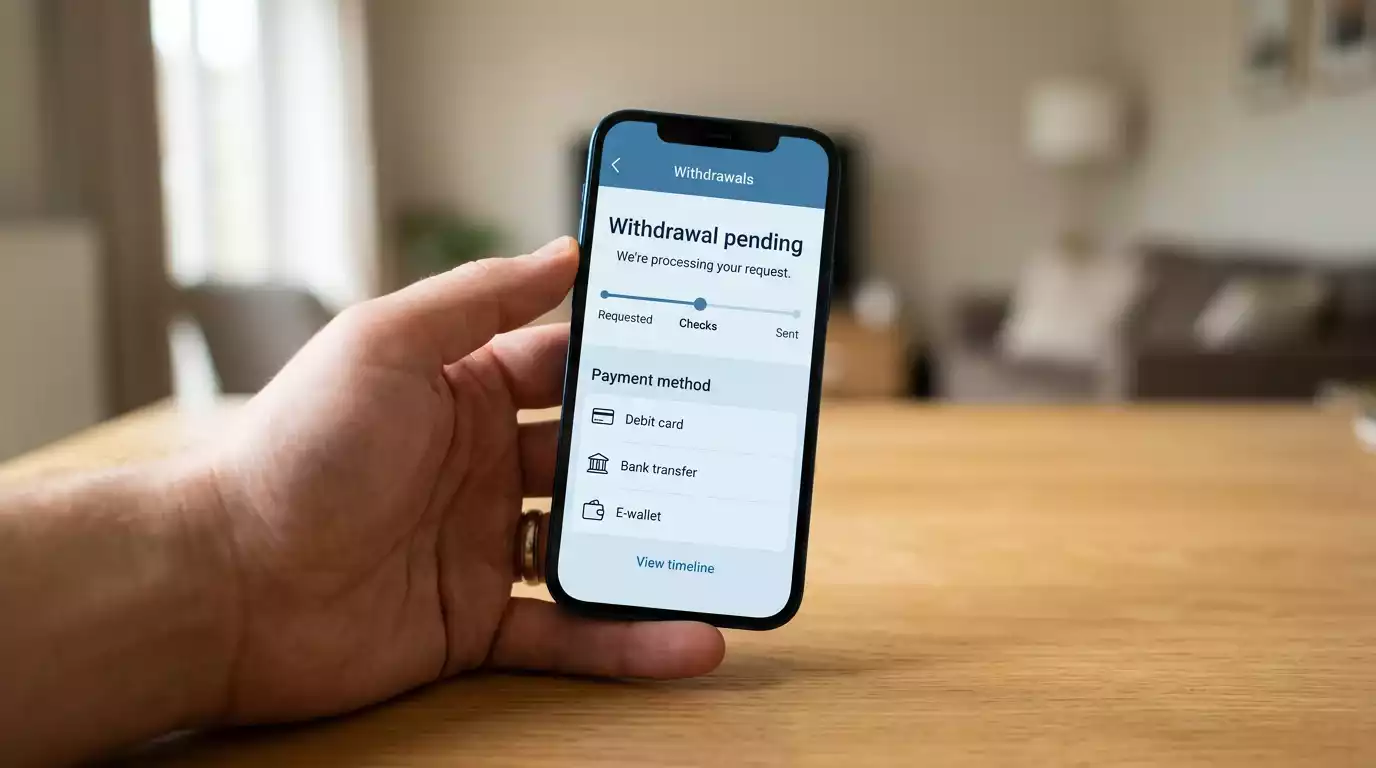
The metric that matters more than the welcome offer
I’ll take a firm that pays out in 30 minutes over one offering a £50 free bet every time. The welcome offer is a one-off. Withdrawal speed is forever — or at least for as long as you hold the account, which for a serious punter is years rather than weeks. And the variance across UK-licensed operators on withdrawal timing is genuinely wide: same £1,000, same day, same bank, one firm pays in an hour, another takes five working days. That gap is not a trivial customer-experience difference. It’s a real friction cost on any active betting operation, and it rarely features in the “best bookmaker” reviews that lead with bonus structures.
This article covers the typical withdrawal windows at UK firms, how payment methods affect speed, why verification delays happen and what they typically signal, and the minimum and maximum limits that quietly constrain what you can actually get back each day. The aim isn’t to rank specific operators — it’s to give you the framework to assess withdrawal speed as a criterion when you choose where to hold an account.
Typical withdrawal windows
The spread across UK-licensed bookmakers in 2026 runs approximately as follows. Fast firms: instant withdrawals to debit card and PayPal, 30 minutes to 2 hours in normal cases, with a hard commitment to payout within the same working day. Mid-tier firms: 24 to 48 hours standard, with some payment methods (bank transfer in particular) taking up to 3 working days. Slow firms: 3 to 5 working days as standard, with no fast-payment options for the majority of customers. Each tier exists. Each is still UKGC-licensed.
The average across the industry has tightened meaningfully over the last five years. Five years ago, 5 working days was a common industry standard; today, 24–48 hours is the median and 5 days is at the slow end of the market. The direction of travel has been toward faster payments, driven partly by competitive pressure from firms leading on speed and partly by payment-infrastructure improvements (instant card push-through, Faster Payments adoption at banks, better-designed bookmaker back-ends).
What “withdrawal time” actually measures is the interval between you clicking “withdraw” and the funds appearing in your bank account. Some firms quote only the internal processing time — “we’ll release your funds within 2 hours” — while the bank takes another 24 to 48 hours to credit the account. Other firms quote the total customer experience, from click to credit. Reading the published numbers requires checking which kind of measurement the firm is using, and customer forum reports usually give a better picture of real-world experience than the firm’s own marketing.
Payment methods and speed
Debit cards are the fastest common method at firms offering instant withdrawals. The technical mechanism — Visa Direct or Mastercard Send — pushes funds directly to the card’s associated bank account in minutes, provided the card issuer supports inbound push payments. Most UK banks do. A small number of cards, particularly prepaid or newer fintech-issued ones, don’t — check with your bank if a card withdrawal is unexpectedly slow.
PayPal is the second-fastest at firms that integrate it. PayPal withdrawals are usually instant to the PayPal balance; moving funds from PayPal to a UK bank account takes another 1 to 2 working days via the standard PayPal-to-bank transfer. If speed to usable funds is the criterion, PayPal is fast only if you’re comfortable holding balance in PayPal rather than in your bank account.
Bank transfer (Faster Payments, BACS, or international equivalents) varies widely. Faster Payments should move funds in minutes — but many bookmakers don’t actually use Faster Payments for withdrawals, instead using slower BACS or combined-batch transfers that take 1 to 3 working days. If bank transfer is your only option at a specific firm, expect the slower end of the range.
Crypto withdrawals at UK-licensed bookmakers are rare — most UK-licensed firms don’t offer crypto at all — but where available, they tend to be fast once confirmed on the blockchain. The catch is that crypto withdrawals usually trigger additional verification for anti-money-laundering reasons, which means the end-to-end experience is often slower than debit card despite the fast on-chain settlement. For UK punters, crypto is rarely the optimal withdrawal method even where it’s available.
One pattern across UK operators: the 24.4 million active accounts registered with UK remote betting firms at end of March 2025 collectively generate huge volumes of withdrawal activity, and payment-infrastructure costs are a material component of operator economics. Firms differentiate on speed because the infrastructure choices that enable faster payments cost money, and those costs are a genuine competitive factor.
Verification delays and why they happen
A withdrawal that’s stuck in “pending” for longer than the firm’s advertised window is almost always a verification delay. The trigger can be routine — a first withdrawal over a certain threshold typically requires completion of KYC that wasn’t needed for deposit — or elevated — an affordability check that requires document submission before the withdrawal releases.
Typical KYC verification on a first substantial withdrawal asks for photo ID and proof of address. This should complete within 1 to 2 working days if the documents are clear and match the account details. Where the account name doesn’t match the ID document, or the address on file doesn’t match the proof of address, the process extends into manual review and can take a week or more. If you’ve moved house since opening the account, update your address before initiating a large withdrawal; this is an avoidable source of delay.
Elevated verification — source of funds requests, enhanced affordability checks — can hold withdrawals for weeks. The Racing Post Big Punting Survey 2025 found 61 per cent of respondents who had been asked for financial documentation refused to provide it, which creates its own resolution pathway: the account closes, the balance pays out after a delay, and the relationship ends. Complying speeds the resolution; refusing extends the delay but doesn’t eliminate the payout, which typically happens after the operator applies formal account closure procedures.
A specific UK context point: 3,086 licensed operators existed in Great Britain at March 2025, down 2.3 per cent year on year. In a consolidating market, firms have tightened verification procedures to protect against regulatory penalties, which has lengthened average withdrawal times on accounts triggering elevated checks. The fast-end of the market has maintained its speed on routine withdrawals; the average has shifted upward on non-routine cases.
Minimum and maximum withdrawal limits
Every UK-licensed operator publishes minimum and maximum withdrawal thresholds, and the specific numbers vary. Minimum withdrawals at typical firms are £5 or £10 — low enough that they rarely constrain anyone. The maximum limits are the ones that matter for serious punters.
Daily withdrawal maxima at mid-market firms typically run from £10,000 to £25,000 per 24-hour period, with weekly or monthly caps stacking on top — £50,000 to £100,000 weekly, for example. For most punters these limits never bite. For winning punters with five-figure weekly activity, or punters cashing out a major festival win, the caps can slow withdrawal of a substantial balance across several days or weeks.
Maximum limits vary by payment method at some firms: a £25,000 daily cap might apply to bank transfer but a £5,000 daily cap to debit card. Reading the full fee and limit schedule is the only way to know what constrains your specific scenarios. Firms with complicated tiered structures often bury the limits in sub-pages; easier-to-find structures are a customer-friendliness signal in their own right.
One practical tip for large withdrawals: split them across multiple days in smaller amounts if your winnings are time-sensitive (tax year end, specific bank transfer deadlines). A single £20,000 withdrawal might sit in manual review for a week at some firms; four £5,000 withdrawals over four days often process faster because they fall under different verification tiers. This isn’t universal and shouldn’t be treated as exploitation of the system — it’s just pattern recognition about how operator verification thresholds function.
Finally: always know your withdrawal position before placing large stakes. Depositing £5,000 to bet on a festival card, winning £15,000, and then discovering your account has a £2,500 daily withdrawal limit is a bad discovery to make post-win. Check the limits when you open the account, not when you try to withdraw.
For the wider picture on choosing a UK racing bookmaker — where withdrawal speed fits alongside BOG, extras, pricing and verification — our guide to choosing a UK horse racing bookmaker puts the banking criteria into the full assessment framework.
Can I speed up a pending withdrawal?
Sometimes, by completing any outstanding verification steps immediately — submitting any requested documents through the secure portal rather than waiting for reminder emails. If the withdrawal is stuck for routine KYC, resolving the document request often unlocks payment within the same day. If the delay is due to enhanced affordability review, the only way to speed things up is to comply with the documentation request or accept that the account will close and the balance will pay out through the closure process.
Which methods are fastest for UK bank accounts?
Debit card is typically fastest for firms offering instant card withdrawals via Visa Direct or Mastercard Send — 30 minutes to 2 hours end-to-end in normal cases. PayPal is fast into the PayPal balance but adds 1–2 working days to transfer to a UK bank account. Bank transfer via Faster Payments can be almost instant where firms use it but often falls back to slower BACS transfers in practice. Debit card is the most reliable fast option at UK bookmakers offering it.
Created by the ”Betting for Horse Racing” editorial team.