Why UK Punters Are Migrating to Unlicensed Racing Sites
 Available in US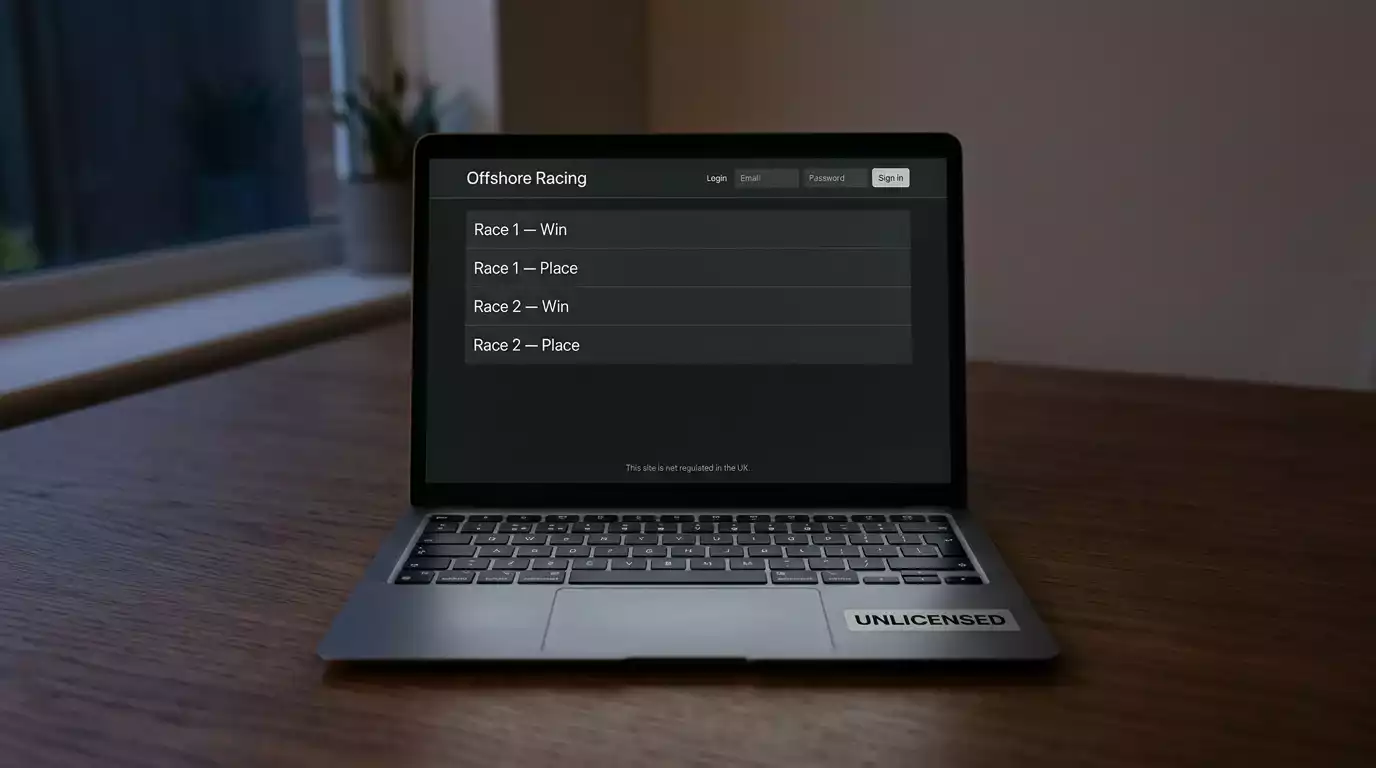
The 522 per cent shift most people haven’t clocked yet
When I first saw the IFHA number I thought it was a typo. Unique visitors to twenty-two unlicensed racing betting sites targeting UK customers rose by 522 per cent between August 2021 and September 2024. Not 52 per cent. Five hundred and twenty-two. Over the same period, traffic to the licensed UK bookmakers grew 49 per cent in unique visitors and 25 per cent in total visits. The ratio tells its own story: offshore growth is outpacing legal growth by an order of magnitude, and the regulatory environment that created this pressure was explicitly designed to protect consumers.
I’m not going to celebrate the migration, and I’m not going to tell you how to find offshore sites. This article does the opposite job – it explains why the shift is happening, what the structural pull factors are, and where the real risks sit for anyone tempted to cross the line. The black market’s growth is a visible outcome of the compliance framework; that doesn’t make betting with unlicensed operators wise. It makes it predictable.
The IFHA 522 per cent finding
The International Federation of Horseracing Authorities published its Council on Anti-Illegal Betting and Related Crime report in early 2025, tracking twenty-two unlicensed betting sites known to carry British horseracing markets and target UK customers. Across the monitored 38-month window, unique customer visits rose from a small base to a figure 522 per cent higher by September 2024. The growth was non-linear – the biggest acceleration correlated with the introduction of enhanced financial checks by UK operators during 2023 and into 2024.
The report is careful not to claim causation by a single factor, because black market migration is a multi-cause phenomenon. What the data does show is that the curve steepens specifically after public announcements of tighter affordability rules, and flattens during quieter regulatory periods. The correlation with compliance tightening is strong enough that the British Horseracing Authority described the trend in its response as “concerning threat becoming reality” – policy language for “we warned about this and here it is”.
To put the 522 per cent figure in context: across the same period, the overall UK licensed online betting market grew modestly, and the UK licensed horse racing segment contracted – British racing saw total betting turnover fall 9 per cent in Q1 2025 compared with Q1 2024, and 4.3 per cent across 2025 against the prior year. Racing handle was leaving the licensed system while overall online handle stayed flat. The money didn’t vanish; it moved.
Push factors – affordability and restrictions
The Racing Post Big Punting Survey 2025 found 63.6 per cent of respondents who had used an unlicensed operator named affordability checks as their primary reason – up from 51 per cent two years earlier. That jump is the clearest signal in the data. The push is not abstract consumer dissatisfaction; it’s a specific compliance experience that pushed a specific cohort offshore.
What the survey respondents described, in the open-text portions of the data, sorted into a few consistent complaints. Repeated document requests that exceeded what they felt the stake level justified. Restrictions applied without clear explanation or appeal process. Accounts closed entirely after refusal to provide bank statements or payslips. And a sense – real or perceived – that the more informed they were as punters, the more likely they were to be restricted. Some of those complaints are legitimate, some reflect misunderstanding of the regulatory framework, and some reflect both. The punter’s felt experience doesn’t care about the apportionment.
A second push factor is account restriction. I covered restrictions in an earlier article in this series – 44 per cent of Big Punting Survey 2025 respondents reported restrictions on at least one licensed account, up from 35 per cent two years earlier. A punter who has been stake-factored on three UK licensed accounts has two realistic paths: bet smaller at licensed operators, or find a route to full-stake betting elsewhere. Offshore sites offer full stakes and no restrictions, at least initially – that’s the pull side of the equation, which we’ll come to.
The push dynamic compounds in ways the initial policy-makers may not have fully modelled. A customer restricted at one licensed bookmaker often shares information with peers, who learn what to avoid, which further shifts activity away from operators perceived as restrictive and towards either alternative operators or, increasingly, the unlicensed segment. Sebastian Butterworth at Flutter UKI observed in early 2025 that “even people with average stakes of £10 are turning to unlicensed operators on the black market who invest nothing in safer gambling and player welfare” – a remark that captures the median migrant rather than the sharp end of the market.
Pull factors – bigger limits, no checks
Unlicensed sites compete for UK customers on three axes the licensed sector has largely conceded. First, no affordability checks. No document requests. No KYC friction beyond a name and email. The onboarding takes ninety seconds. Second, higher stake limits – often ten to fifty times what a restricted UK account would accept. Third, bonus structures that wouldn’t pass UKGC advertising standards: matched deposits of 200 per cent, free-bet stakes in the hundreds, cashback promotions layered on top of welcome offers.
These aren’t benign product features. They are carefully engineered acquisition tools, because unlicensed operators have no obligation to promote safer gambling, contribute to the Levy, or pay UK taxes. Yield Sec’s research estimates that illegal operators held around 9 per cent of the UK online betting market in the first half of 2025 and generated approximately £379 million in revenue in that period. That revenue, entirely, is extracted from the UK consumer base without flowing into the regulated ecosystem – no £26 million UKGC enforcement funding boost, no £108.9 million annual Levy yield into British racing, no consumer redress pathway.
The pull also operates psychologically. A customer who has had a frustrating compliance experience at a licensed firm tends to interpret the unlicensed alternative’s frictionless onboarding as relief. That relief is conditional. The conditions don’t become visible until something goes wrong – which is where we head next.
The real risks for the punter
The first risk is dispute resolution. If a licensed UK operator freezes your balance or refuses a withdrawal, you have a complaints process, a regulatory oversight body, and an ADR provider. If an unlicensed operator does the same, you have no recourse inside the UK legal system. The Gambling Commission cannot compel an offshore unlicensed operator to pay you. UK consumer protection law applies only to entities operating under UK licence. Your balance is, legally, gone the moment the operator decides it is.
The second risk is identity and financial data exposure. Unlicensed operators have no UKGC data-handling obligations. Some are well-run commercial entities with solid security practices; others are not. There is no independent way for a UK customer to verify which is which, because there is no regulator performing ongoing audit of those operators. Every deposit using card, bank transfer, or wallet leaks customer data to a counterparty you cannot vet.
The third risk is banking. UK banks increasingly screen outbound transfers to entities flagged as offshore gambling operators. Some deposits don’t go through. Some do but are reversed by the bank’s fraud team. Some go through and appear in statements with merchant codes that trigger bank-side internal risk reviews – which can affect your mortgage application, credit card approvals, and account standing independently of any gambling outcome.
The fourth risk is integrity. Licensed UK bookmakers are bound by the BHA’s integrity regime; unlicensed operators are not. Match-fixing, insider-trading markets, and manipulated pricing are all commercially available business models for unlicensed operators. You may be trading against people with race-day information flows you cannot match, on markets where the operator itself has arranged the pricing in ways a UK regulator would not permit. These aren’t theoretical risks. IFHA’s report catalogues specific instances.
The fifth risk is criminal-adjacent proximity. Some – not all, but some – unlicensed operators are known to be connected to money-laundering networks, organised crime groups, and fraud rings. Using their services doesn’t make you a criminal, but having your payment data on file with them is a category of exposure most UK punters haven’t properly assessed.
For the regulatory context that shapes this whole dynamic – affordability checks, the migration pressures and the UKGC framework response – our guide to affordability checks and UK horse racing betting provides the full picture.
Is using an offshore site illegal for a UK resident?
Placing bets with an operator not licensed by the UKGC is not itself a criminal offence for the UK punter in most circumstances, but the operator is committing an offence by taking bets from UK customers without a licence. Your account is unprotected by UK consumer law, and you may face knock-on complications with UK banking, tax declarations of winnings, and future licensed-operator account applications where disclosed offshore activity is flagged.
Can I recover funds if an unlicensed site closes my account?
Almost never. The UKGC has no jurisdiction over unlicensed operators, UK consumer protection law applies to entities trading in the UK under regulatory authorisation only, and the operator’s own terms will typically grant them unrestricted authority to close accounts and retain balances. Civil recovery across jurisdictions against an offshore gambling entity is technically possible but rarely economic for any sum a retail punter would hold on account.
Written by the editors at Betting for Horse Racing.