Going at Prestbury Park: Soft, Heavy and Good to Soft Explained
 Available in US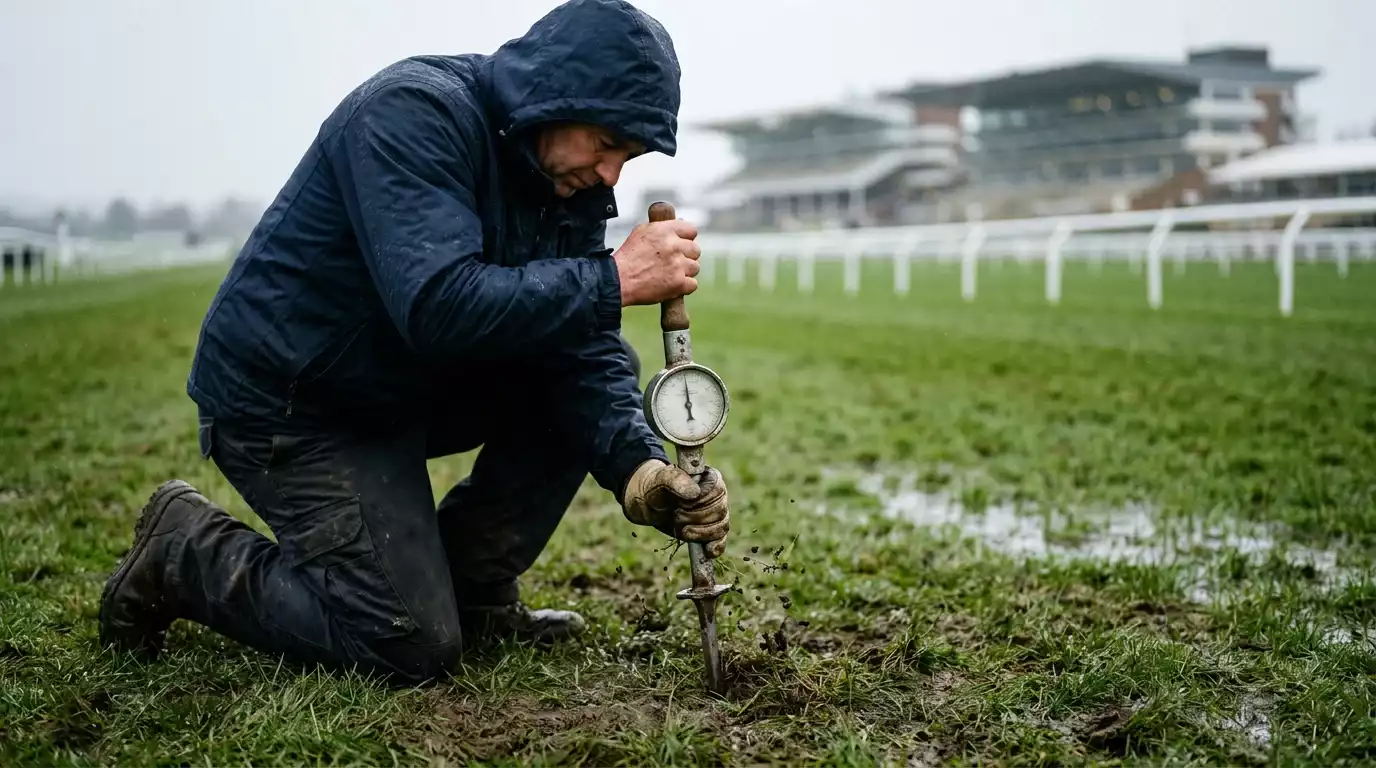
The variable that can re-shape a whole card
Cheltenham 2023 – Thursday morning, heavy rain overnight, ground shifting from “good to soft” to “soft” and in places to “soft, heavy in places” by the time the Stayers’ Hurdle ran. The ante-post favourite – a front-running stayer on quicker ground – had drifted from 5/2 to 5/1 by the off. A different horse, a dour one-paced stayer who hated quicker surfaces, had shortened from 14/1 to 7/1. Both moves were driven by the going description. Not by form, not by trainer news – by two inches of rain. That’s the variable that can rearrange a whole festival in 12 hours, and punters who don’t factor it in are betting on an earlier version of the race than the one that will actually run.
Going at Cheltenham changes faster than ante-post markets do. Understanding the official scale, the numerical going-stick readings that sit underneath the verbal descriptions, and how different going states re-order the field’s chances is the groundwork for anyone betting seriously at the festival. This isn’t specialist form-analysis territory – it’s baseline race-day preparation. And yet the majority of casual festival punters don’t check the going after they’ve selected their horses, which is exactly backwards.
Going descriptions on the official scale
The BHA uses a standardised going scale across all UK racecourses: firm, good to firm, good, good to soft, soft, heavy. On a warm dry spring day, Cheltenham’s course can run good to firm; after a wet winter and through-week rain, it can be described as soft or even heavy in patches. The Festival runs in March, which means the typical going range runs from good to soft through soft – good to firm is rare, heavy is increasingly common in wet years.
The clerk of the course at Cheltenham publishes going descriptions at specific points: approximately 48 hours before racing, 24 hours before, two hours before the first race, and updates through the day as conditions change. The descriptions can use compound terminology – “good to soft, soft in places” – to indicate heterogeneity across the course. Cheltenham specifically tends to ride softer on the inside hurdle track than the outer chase track, and going reports may reflect that split. Reading the full description, not just the headline term, matters.
What’s genuinely important is that going descriptions are judgment calls as much as measurements. The same ground underfoot can be described “soft” by one clerk and “good to soft” by another. The BHA provides guidelines, but track-to-track and year-to-year interpretation varies. This is why the numerical data underneath – the going-stick – is more reliable as a comparison tool than verbal descriptions alone.
Going stick readings
The going-stick is a handheld device that measures two things: the force required to push a metal spike into the ground (penetration) and the force required to rotate the spike (shear). The two measurements produce a single composite number, the going-stick reading, typically quoted to one decimal place. Firm ground reads around 12 and above; good-to-firm around 10 to 11.5; good around 8 to 10; good-to-soft around 6 to 8; soft around 4 to 6; heavy around 4 and below.
At Cheltenham, going-stick readings are published alongside verbal descriptions. A reading of 7.2 on Tuesday morning moving to 5.4 by Thursday evening tells you the ground has softened materially during festival week, even if the verbal description is still “soft”. That numerical detail lets you compare going states across days and across years: a horse who ran well when Cheltenham read 6.1 a year ago is a genuinely similar match if the current reading is 6.0, regardless of whether the verbal description is identical.
For serious horse-profile work, tracking going-stick readings alongside performance in individual horses’ form is where preference analysis gets more precise. Trainer comments about “preferring soft ground” are often slightly misleading – the horse may actually prefer a specific going-stick band, say 5.5 to 7.0, which encompasses both the top end of “soft” and the bottom end of “good to soft”. Numerical readings reveal preferences that verbal labels blur.
Impact on favourites and longshots
Softer ground generally flattens the form book. The difference in class between a 2/1 favourite and a 20/1 longshot narrows when the ground slows times down, because stamina becomes more important relative to speed, and stamina is more evenly distributed across fields than raw class is. On heavy ground at Cheltenham, you’ll typically see longer-priced horses placing more often than they would on good ground – the place-pool dynamics shift, each-way bets pay out more frequently, and outsider wins become more probable.
The specific horses who benefit from soft ground are usually clear from their form. Horses whose career-best performances have come on yielding or heavy ground carry genuine advantage when conditions match; horses whose best form is on good-to-firm get exposed on softer surfaces. The exception is horses stepping up to Grade 1 class for the first time – at top level, ground preferences matter slightly less than at lower grades, because the class gap is wider relative to the going impact.
Specific races react differently to ground. The Stayers’ Hurdle is probably the most ground-sensitive of the championship races, because the three-mile distance amplifies small stamina differences on softer ground. The Queen Mother Champion Chase is less sensitive – two miles over fences at racing pace is a similar test across most going states, with only extreme heavy ground materially changing the profile. The Gold Cup sits in between; soft ground helps genuine stayers with proven heavy-ground form, but extreme heavy can produce upsets where stamina-plus-jumping-in-mud beats class.
All 28 races at the festival ranked among the top 31 most-backed races of 2025, with William Hill projecting £450 million wagered over the four days in 2026. Into that volume, going changes in the final 24 hours can shift market positions by 50 per cent or more on ground-sensitive horses. Being ready to react – taking positions on horses who benefit from a going change while they’re still priced for the old going – is where quick thinking on festival mornings pays off.
Reading weather into race day
Weather forecasts for Cheltenham during festival week are watched more intently than for most events in British sport, and forecasting accuracy for the Cotswolds in March is decent rather than excellent. Rain bands moving across the west of England can deliver anywhere from a trace to two inches over a 12-hour window, and the difference between “one millimetre overnight” and “ten millimetres overnight” completely changes which horses are genuine contenders.
My practical working rule: check the Met Office forecast and at least one private weather service twice a day during festival week. Track rainfall totals rather than just “will it rain” – cumulative millimetres matter more than individual showers. If forecast rainfall exceeds 15mm in the 24 hours before racing, expect going to soften by one full description category; if it exceeds 25mm, expect soft or heavy conditions regardless of the current state.
The timing of rain matters too. Rain at 4am on a racing day has had time to drain and partially absorb by the first race at 1.30pm; rain at 10am hasn’t drained and sits on the surface. Morning rain has a bigger impact on afternoon going than overnight rain of the same volume. Track drainage also varies by location on the course – the hurdle track and chase track at Cheltenham drain differently, and the impact of rain on each isn’t uniform.
For ante-post positions placed before race week, weather risk is asymmetric – going changes always alter some horses’ chances negatively and others’ positively, but your ante-post bet is locked in. Factor this into stake sizing: ante-post on ground-sensitive horses is a bigger variance bet than ante-post on ground-neutral contenders. Horses with clear preference on one specific going state require more cushion in your stake than horses who’ve run respectably across multiple going states.
For the full picture of betting across the four days of the festival – Champion Hurdle, Queen Mother, Stayers’ Hurdle, Gold Cup – our Cheltenham Festival betting playbook puts ground analysis alongside the race-by-race angles for the whole meeting.
How late can going changes affect my bet?
Going can change materially up to the moment the first race runs, and occasional further changes happen during a card if weather shifts mid-afternoon. For pre-race bets placed in the morning, the going at race time may differ from the going at bet time. Some UK bookmakers allow cash-out on win bets up to the off, which provides an exit if going shifts against your position; ante-post bets and bets without cash-out availability run to the race as placed, with no adjustment.
Does heavy ground help outsiders?
Generally yes, though not universally. Heavy ground flattens form by reducing the importance of raw speed and elevating stamina, which narrows the performance gap between class horses and lesser ones. Outsiders who’ve previously shown good heavy-ground form become materially better chances under those conditions; outsiders without any heavy-ground form don’t automatically improve just because the ground is soft. Match the horse’s proven surface preferences to the current going rather than applying a blanket ‘soft helps outsiders’ rule.
Where can I find the going-stick reading for a Cheltenham meeting?
Going-stick readings are published by the clerk of the course and distributed through the main UK racing news channels – the Racing Post, ITV Racing and the BHA’s own feeds all carry them. They’re also visible on racecourse display boards on the day, and most UK bookmakers’ race-page descriptions include the current going-stick reading alongside the verbal going description. Check at least two sources on festival mornings because updates can lag between channels.
Created by the ”Betting for Horse Racing” editorial team.