Forecast and Tricast Bets: Predicting Finish Order in UK Racing
 Available in US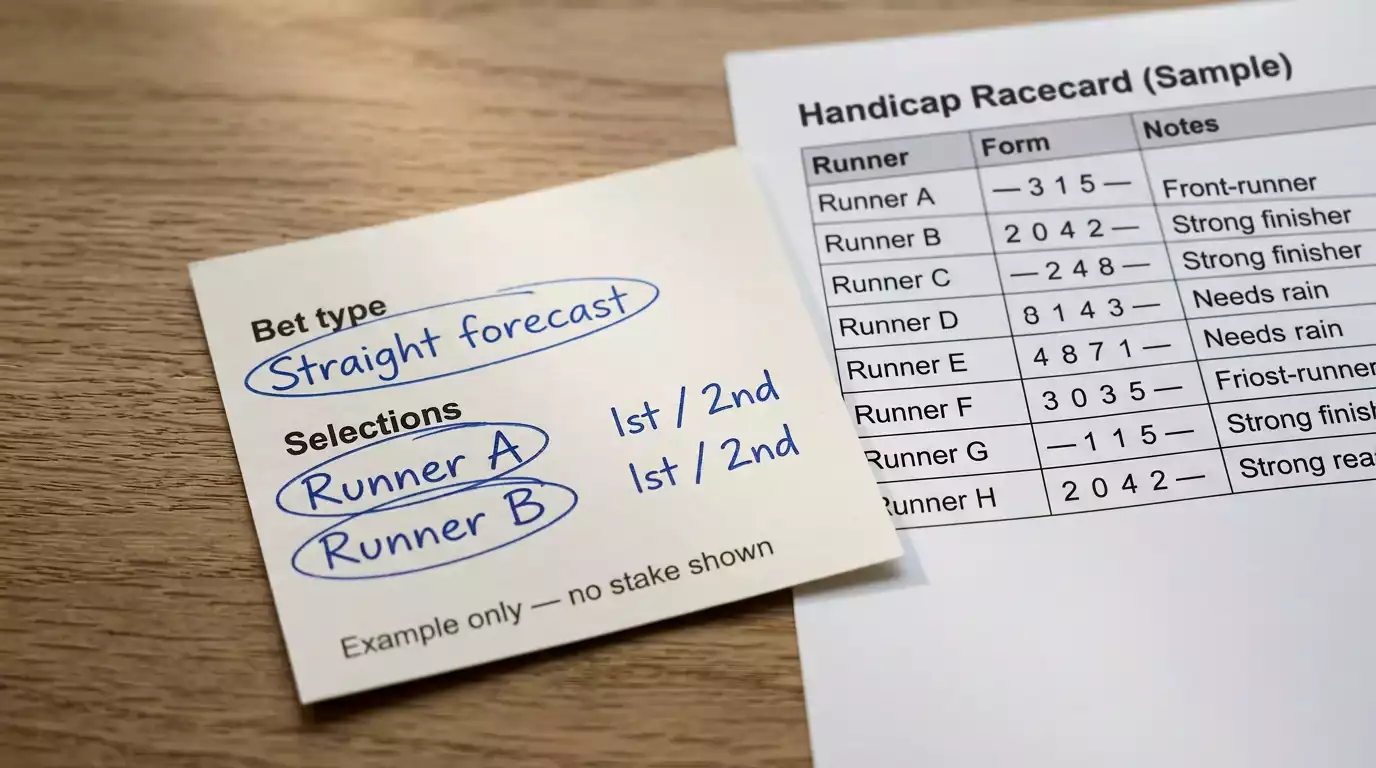
The bet that punishes “nearly right”
I once watched a mate shout “yes!” when the horse he’d straight-forecast landed, then shout louder when the horse he paired with it finished second – and then go very quiet when he realised they’d crossed the line the wrong way round. Two correct horses. Wrong order. Losing slip. Forecast and tricast bets are the only markets in UK racing that punish being nearly right. You can pick the first two or three finishers and still lose, because order is everything.
This is also what makes the category interesting. The dividends are meaningful because the bet is hard. A straight forecast on a 12-runner handicap pays, on average, three to four times what the win price paid on the same horse. Get the order wrong and you own the loss. Get it right and you’ve extracted a price the win-only market doesn’t offer. The mechanics are straightforward; the discipline of knowing when to use them is where the edge sits.
Straight forecast mechanics
A straight forecast nominates two horses to finish first and second in that exact order. Name them A and B. Your bet wins only if A wins and B is second. B winning and A second is a losing slip. £2 minimum stake at most UK firms, same at the Tote, and the return is calculated using a formula called the Computer Straight Forecast – CSF – which we’ll unpack in a moment.
The structural point worth absorbing is that a straight forecast is not a combination. It is a specific sequence. You are saying “this horse beats that horse by at least a length”, which is a very different statement from “these are the two best horses in the race”. A lot of novice forecast bets are actually the second kind of statement disguised as the first, and the disguise costs money.
Where straight forecasts work: races where you have a strong view on the winner and a secondary horse you think will run second because of some specific factor – the pace bias, the draw, a stablemate angle. Where they don’t work: races where you just think “these two are the form horses”. If you don’t have a directional view on which beats which, you don’t have a straight forecast bet.
Reverse forecast and combination
A reverse forecast is two straight forecasts: A to beat B, and B to beat A. Either order wins. £2 minimum stake per forecast, so a £2 reverse forecast is actually £4 total stake. Whichever horse wins, if the other is second, the bet settles on the CSF of that specific pairing.
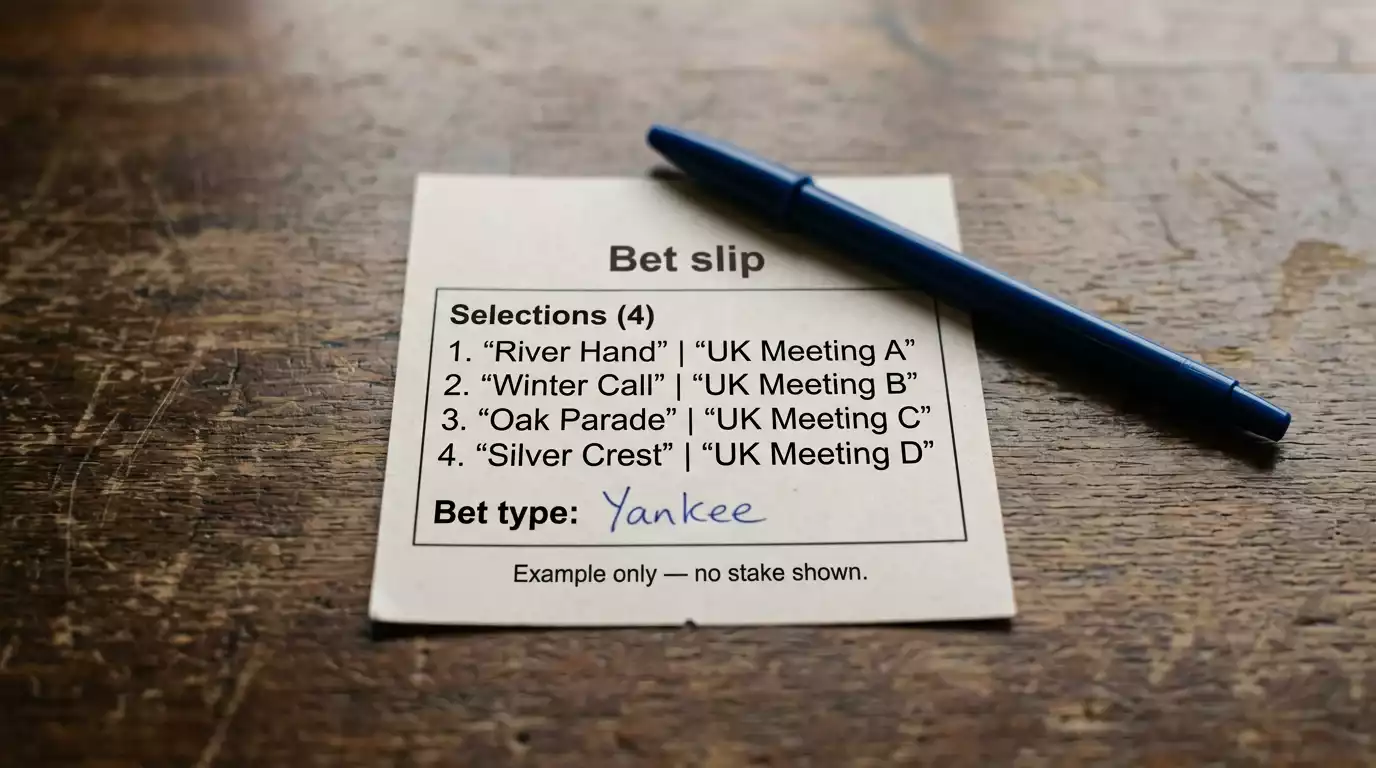
The combination forecast extends the logic across three or more selections. A three-horse combination is three straight forecasts – A-B, B-A, A-C, C-A, B-C, C-B – which is six bets and, at £2 each, twelve quid total. You get the first two correct in any order between your three horses. The cost scales quickly with the number of selections because combinations expand factorially, which is something I see punters miss on a Saturday slip when they name five horses and assume they’ve backed “the obvious ones”.
Reverse forecasts are the right tool when you think two specific horses are head-and-shoulders best in the race but you can’t call the order. Combinations are the right tool when you’re sure the first two will come from a pool of three or four, and you’re willing to stake multiple times for the flexibility. Both bet types reward narrow conviction about who’s involved, not wide conviction about the shape of the finish.
Tricast and the three-horse finish
Tricast nominates the first three in exact order. Harder bet, bigger dividend. £1 minimum at most UK firms – the lower stake floor reflects that even correct selections rarely complete the sequence, so the industry keeps the entry cost down. A tricast won’t run on every race; most bookmakers require at least eight runners for tricast markets to open, and computer-forecast settlement takes over for tricasts the same way CSF does for forecasts.
The dividends can be eye-watering. A tricast on a 14-runner handicap where the first three come in at 6/1, 7/1 and 10/1 can pay several hundred quid to a pound stake. That’s the mathematical inverse of how hard the bet is to land. Across a full season of UK handicaps, I’d estimate the hit rate on a genuinely researched tricast at well under 5 per cent even for sharp punters, which means you need the occasional four-figure slip to justify the strike rate. Plan for variance.
Combination tricasts – naming four or more horses to fill the first three in any order – are where the cost genuinely explodes. Four selections in a full combination tricast is twenty-four bets. At £1 each that’s £24 for a single race. Five selections is sixty bets, £60. Very few races justify that spread. The firms that publish clear combination-tricast slip calculators do their punters a favour; the ones that bury the total behind a small-print “total stake” line arguably do the opposite. Check the total before you confirm, always.
On minimum field size: if a race that opened with a tricast market drops below the required runner count because of withdrawals, the bet usually downgrades to a forecast – first two only, computer-forecast settled – and any additional selections in your tricast beyond the top two are ignored. Read each firm’s rules, because the downgrade behaviour varies and it can swing whether a slip pays at all.
CSF and how dividends are actually calculated
The Computer Straight Forecast dividend is calculated by a formula that takes into account the SPs of every runner in the race, not just the two you picked. The logic: a forecast pairing a 5/1 chance with a 3/1 chance in a wide-open handicap pays more than the same pairing in a race where everything else is a 33/1 longshot, because the computer recognises the relative difficulty of the sequence across the full field. That’s why two punters can stake identical forecasts on the same two horses across different races and see wildly different returns.
The CSF was introduced because the old tote-forecast market paid out based on pool money only, which could be distorted by a handful of big bets. CSF gives a stable, formula-driven number that applies across all UK-licensed bookmakers and reflects the full field’s market. Tricast dividends work on an analogous three-horse version of the formula. The practical upshot: you don’t know exactly what your forecast or tricast will pay until the race is declared and the computer grinds through its sums, which is why returns are quoted to the penny after settlement rather than displayed as odds beforehand.
This formula-based settlement is also why you sometimes see dividends that look “wrong” – too low for the prices involved, or surprisingly high on a short-priced pair. The formula accounts for field depth and SP distribution in ways that a mental calculation using just the two horses’ own prices doesn’t capture. If a settled forecast looks off, it usually means the rest of the field behaved unusually in the market, not that the bookmaker short-changed you. UK betting turnover fell 4.3 per cent in 2025 against 2024, and in a thinner market CSF formulas can flex in both directions more than they used to, so expect occasional surprises on dividend day.
Minimum field sizes and the rules that settle your slip
Forecast markets typically require a minimum of three declared runners, though in practice bookmakers won’t price forecasts on very small fields because the dividends become trivial and the market uninformative. Tricasts typically require eight runners minimum, with some firms lifting the floor to ten for certain race types. Handicaps are the primary tricast market – tricasts on small-field conditions races are rare because the dividend wouldn’t reward the difficulty.
Non-runners are the nuance that catches punters out. If a horse you named in a forecast or tricast is withdrawn before the off, the bet doesn’t automatically settle as a loss – the rules vary by firm and by when the withdrawal occurs. For ante-post forecasts and tricasts, non-runner concessions are less common than for win or each-way bets, which matters if you like locking in festival tricasts early. Day-of-race forecast bets on withdrawn horses typically lose stake on that line, or in the case of a combination bet, lose the portion of stake allocated to combinations involving the withdrawn horse. Always, always read the rule page.
Dead heats in forecasts and tricasts follow the same principle as other UK bets: stakes are reduced proportionally and settled as partial winners, which produces some of the lowest dividend figures you’ll see in the category. A dead heat for second on a tricast where you named that horse to finish second settles at half the expected return, with the other half lost. It’s a rare enough event that most punters never encounter it, but when it happens it is a distinctive kind of small consolation.
For the wider context on how forecast and tricast settle compared to the other markets you might stake on the same race, our UK horse racing bet types guide runs through each market back-to-back.
Why is my forecast dividend different from what I calculated?
Because UK forecast dividends use the Computer Straight Forecast formula, which factors in the SPs of every runner in the race – not just the two horses you named. A pair priced 5/1 and 3/1 can pay very different amounts in races with different field depth and SP distribution, because the computer scales the dividend to reflect how hard the sequence was to find in that specific field.
Can I place a tricast on any UK race?
No. Most UK bookmakers require a minimum of eight declared runners for tricast markets to open, and some lift that floor to ten for certain race types. Tricasts are mainly offered on handicaps and larger-field races where the dividend potential justifies the bet’s difficulty. If the field drops below the minimum, a tricast typically downgrades to a forecast settlement.
Created by the ”Betting for Horse Racing” editorial team.