Lucky 15, Lucky 31 and Lucky 63: Are Permutation Bets Really Worth It?
 Available in US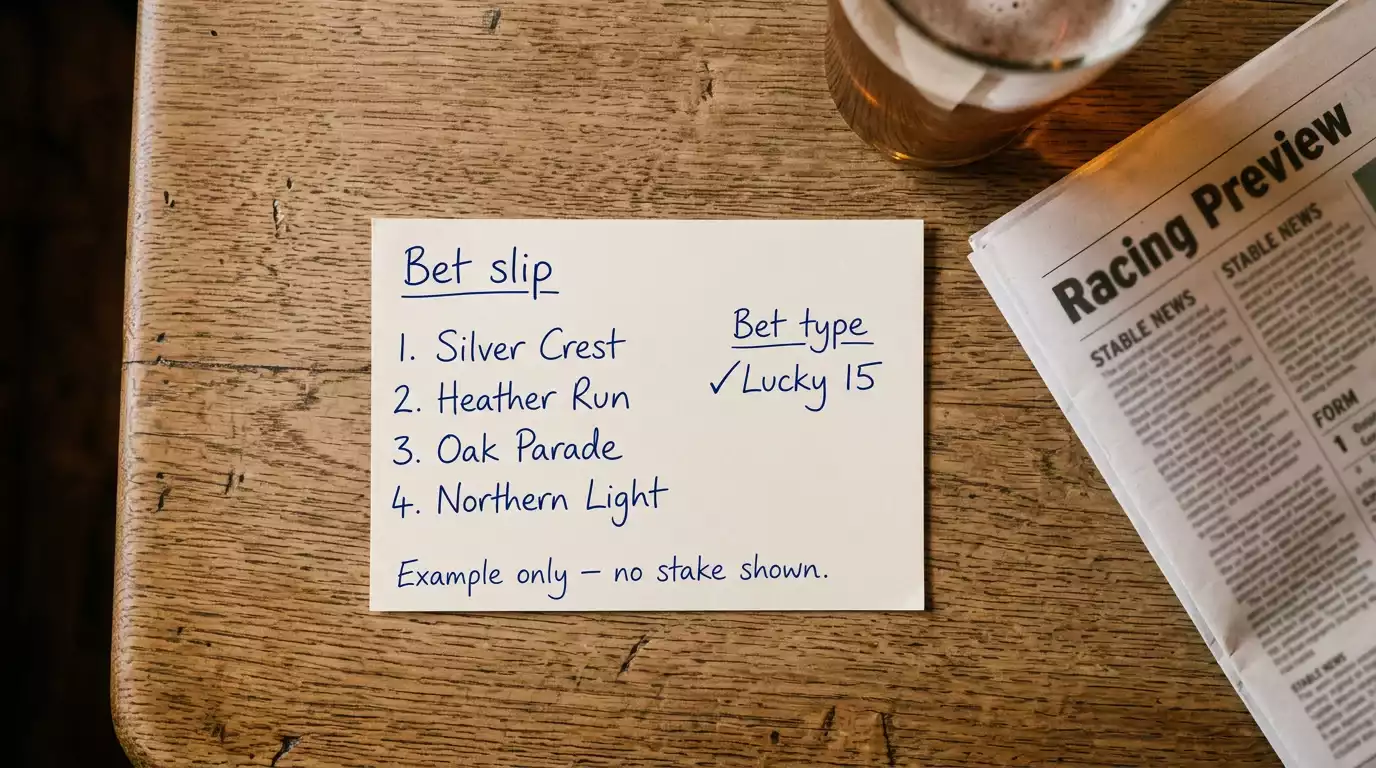
The conversation every Saturday morning
Every weekend I get some version of the same message: “Four horses I love – should I Lucky 15 them?” And nine times out of ten the honest answer is: maybe, but not for the reason you think. A Lucky 15 is not one bet. It is fifteen bets, stacked onto a single slip to save you time at the counter, and the difference between “one bet” and “fifteen bets” is the difference between a sensible punt and quietly staking £30 on a slow Tuesday afternoon.
The marketing always leads with the bonus. Pick four winners and we’ll double the odds on the singles, treble them if only one wins, pay you a consolation here, a consolation there. It’s attractive. It’s also the reason punters keep coming back after a £30 loss hoping the next one lands. I’m not against Lucky bets – they have a legitimate place, especially on festival days – but they reward specific selection patterns and punish others, and most of the people putting them on aren’t thinking about which is which.
What a Lucky 15 actually is
Strip the branding off and a Lucky 15 is four selections combined into every possible multiple: four singles, six doubles, four trebles and one four-fold accumulator. Fifteen bets. A £1 Lucky 15 costs £15. The “Lucky” is a bonus structure laid on top of that basic shape – usually double odds on the single if only one of your four horses wins, and sometimes a percentage bonus of 10 to 25 per cent if all four come in.
Take a real-feeling example. Four selections at 3/1, 5/2, 4/1 and 7/1. Pick them all and the four-fold alone pays £1 × 4 × 3.5 × 5 × 8 = £560 from that one leg. Add six doubles and four trebles hitting as well and you’re looking at a return several multiples of that, depending on the specific combinations. Pick three of four and your winning bets are three singles, three doubles and a treble – a solid result, not a jackpot. Pick one of four and your one single pays, possibly at double odds under the bonus rules, and the rest lapse.
That last scenario is the one I want you to notice. You can land a Lucky 15 with one winner. But you need the winner at a price long enough that double the single returns beats the £15 stake. A 3/1 winner on a £1 Lucky 15 with double-odds bonus returns roughly £7 – you’re down eight quid. At 7/1 you return £15 – you’re level. At 10/1 plus you’re finally up. One-winner Lucky 15s are only profitable when the winner is a genuine longshot, which is worth internalising before the next Saturday card.
Lucky 31 and Lucky 63 scaled up
Lucky 31 is the same logic with five selections and thirty-one bets – five singles, ten doubles, ten trebles, five four-folds and one five-fold. A £1 stake costs £31. Lucky 63 extends to six selections and sixty-three bets for £63 a pound. The structure is purely combinatorial: every possible subset of your selections becomes its own bet, which is why the numbers scale so sharply.
What changes with scale is not the mathematics of each individual accumulator – it’s how brutal the stake feels when selections start losing. On a Lucky 63, three of your six can win and you still might not cover the stake, because the doubles and trebles involving your three losers all die. The four-fold, five-fold and six-fold all need at least four of the six correct. Unless your three winners include a meaningful price, three from six at average prices often lands you short of £63.
I watched a Royal Ascot regular stake £5 Lucky 63 across six races one year – £315 on the slip. He landed four winners at prices ranging from 9/4 to 10/1. The return was respectable but less than the stake. Four from six felt like a triumph. The slip paid out as a loss. That gap between emotional hit-rate and mathematical result is why scaled Lucky bets need clearer eyes, not more optimism.
Bonus structures across UK bookmakers
The bonuses vary more than punters realise, and this is where a Lucky bet earns or doesn’t. Most UK operators offer double the odds on the single if only one of your four selections wins – that’s the “one from four” consolation. Some go to treble odds. Some run promotions around Cheltenham and Aintree where the all-winners bonus steps up to 25 per cent from a standard 10 per cent.
What you rarely see highlighted is the exclusion list. Bonuses typically don’t apply to ante-post bets, don’t apply if a non-runner leaves your selection short, don’t apply if any selection is the only one on the slip at odds-on, and in some cases don’t apply to Lucky 63s where most of the selections are short-priced favourites. Every operator publishes these exclusions; few punters read them. I’ve had clients insist their double-odds bonus hadn’t applied when in fact their single winner was odds-on, which is excluded at most firms.
My practical rule: before you stake anything on a Lucky of any size, check the current bonus terms at that specific bookmaker for that specific day. Promotions rotate. A festival-enhanced bonus of 25 per cent all-winners might be the difference between a Lucky 15 making sense and not making sense at your chosen selections. Outside festival weeks, standard terms often nudge the expected value back below the line.
The expected value maths worth actually doing
Here is the uncomfortable bit. Work out the expected value of a Lucky 15 and you can stop guessing. The formula is probability of each bet landing multiplied by its return, summed across the fifteen bets, minus the stake. You don’t need a finance degree – a spreadsheet and a willingness to estimate each horse’s true chance gets you there.
Take the £1 Lucky 15 example again. Four horses at 3/1, 5/2, 4/1 and 7/1. The bookmaker’s implied probabilities are 25 per cent, 28.6 per cent, 20 per cent and 12.5 per cent. If those match your own assessment exactly, your expected value is negative – you’d lose the overround, multiplied across fifteen correlated bets. For a Lucky 15 to have positive EV, at least one of your selections needs to be priced meaningfully longer than you think is fair, and ideally more than one. A Lucky 15 on four horses you think are about right is just an expensive way of losing the bookmaker’s margin fifteen times.
This is why the Lucky bet makes most sense on cards where you think several horses are significantly overpriced – festival days when prices get pushed out by mass-market money, or maiden hurdles where trade opinion hasn’t formed. UK betting turnover fell 4.3 per cent in 2025 overall compared with 2024, which tells you volume is down and books are running tighter to protect margin – yet another reason that backing mispriced longshots, not backing favourites who are priced exactly right, is where Lucky bets pay off. Average turnover per race in 2025 fell 5.6 per cent against 2024, which quietly squeezes the overround window everywhere and rewards the punter who picks his spots.
When a Lucky bet actually makes sense
There are three specific situations where I reach for a Lucky 15. First, festival days with enhanced all-winners bonuses, because the boosted top-end return shifts the EV calculation into the punter’s favour when selections are decent. Second, cards where I’ve genuinely identified three or four value prices, not three or four “fancies” – the line between the two is roughly whether I’d back each horse individually for a decent stake without the others on the slip. Third, novelty punts with proper longshots, where landing one winner at 14/1 or 20/1 covers the stake under double-odds bonus rules.
When Luckies don’t make sense: flat handicaps where all four selections are short-priced favourites you only half-believe in, odds-on-heavy accumulators where the bonuses often don’t apply, or a “Saturday morning four-timer” where you picked one from each ITV race with thirty seconds’ research. That last one is the modal Lucky 15 in this country, and it is also the reason the bet type has earned its reputation as a mug’s game. The fault isn’t the bet. The fault is the selection process wrapped around it.
If you want to see how Luckies stack up against the simpler permutation bets – Yankees, Trixies and Patents – our UK horse racing bet types guide sets them side by side so you can pick the right shape for your selection count.
Does the all-winners bonus overcome the extra stake?
Not always. The standard 10 per cent all-winners bonus on a Lucky 15 adds roughly one-tenth to your four-fold return, and whether that beats the £15 stake depends entirely on the prices. At festival-enhanced rates of 20 to 25 per cent on decent-priced selections, yes, it can materially tip expected value positive. On short-priced favourites, the bonus rarely covers the mathematical deficit.
Can I place a Lucky 15 on any UK race?
You can place a Lucky 15 across any combination of races that a bookmaker accepts for multiples, which in practice means nearly all UK racing. The exceptions are certain ante-post markets, some novelty markets and occasionally virtual racing. Bonus structures may exclude specific race types or non-runner scenarios, so check the promotion terms for the day you are placing the bet.
Prepared by the Betting for Horse Racing editorial staff.