How to Read Horse Racing Odds: Fractional, Decimal and Starting Price
 Available in US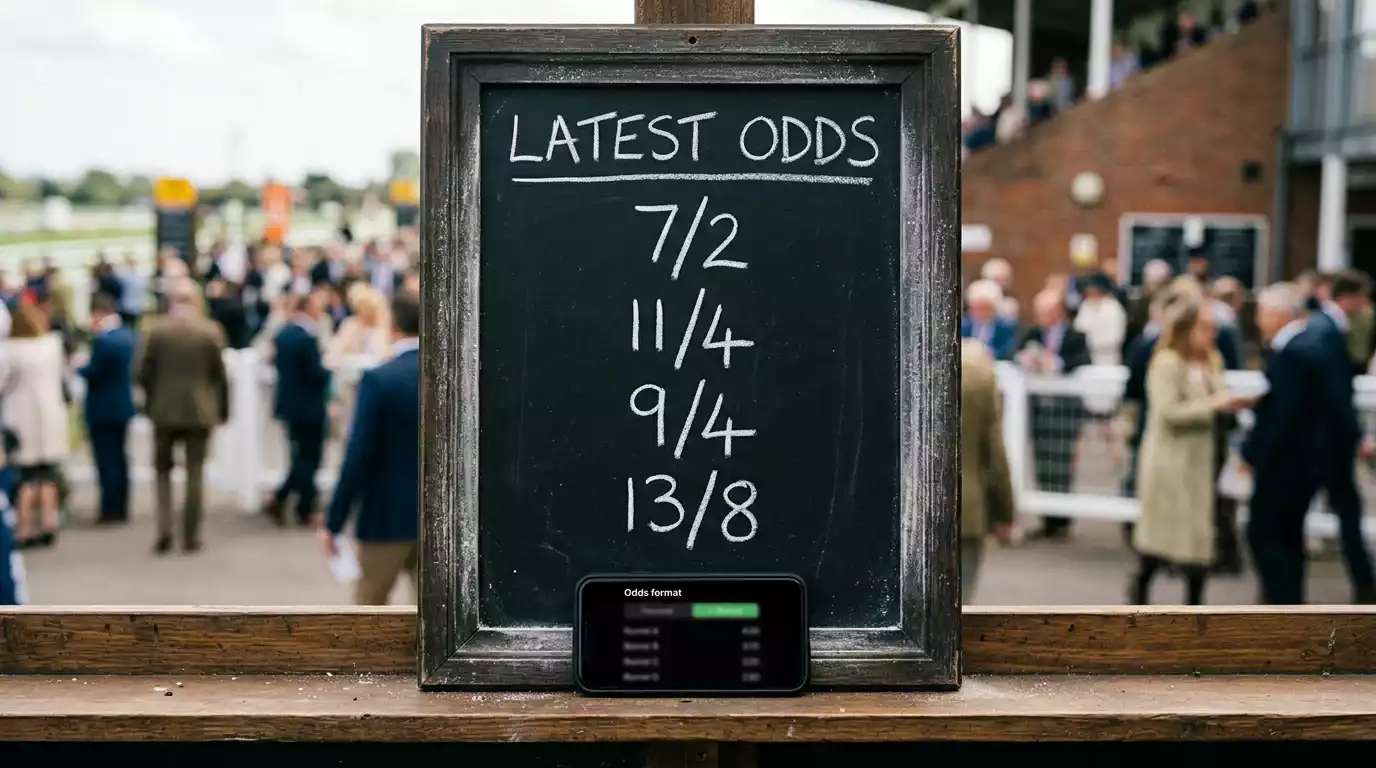
Why odds formats trip up even seasoned punters
The first time I tried to explain 20/1 to a new client, he nodded along until I mentioned the stake returned with the profit – and realised he’d been picturing 20/1 as “twenty times your money”. It is not. It is twenty times profit plus your stake back, which means a winning £1 bet pays £21, not £20. That single misunderstanding costs British punters more confusion than draw bias and Rule 4 combined, and I see it in chat threads every festival.
Odds are just a shorthand for price, and once you can flip between fractional, decimal and starting price without reaching for a calculator, most of UK racing starts to make more sense. The board at Cheltenham will still be chalked in fractions. Your app will still show decimals. And when your bet settles, it will often settle at SP, which is a third animal entirely. In this piece I walk through each format, show you the conversions I actually use at the track, and unpack the bit no one explains properly – overround and why the bookmaker is always a step ahead of the arithmetic.
Fractional odds and what they really tell you
I still remember arguing with a mate about whether 11/4 was “nearly 3/1” or “worse than 3/1”. He thought bigger numerator meant bigger price. It doesn’t, not straightforwardly. 11/4 pays £11 profit for every £4 staked, which is £2.75 profit per £1 – worse than 3/1, which pays £3 profit per £1. You have to do the division, and that trips people up at 13/8, 9/4, 5/2 and the rest of the Ripon Tuesday price ladder.
The mechanics are straightforward once you accept the pattern. The first number is profit, the second is stake, and to find your return you add the stake back. A £10 bet at 7/2 returns £45 – that’s £35 profit plus your £10 back. A £10 bet at 1/2 (odds-on) returns £15. Whenever you see a price with the second number larger than the first – 1/2, 4/6, 2/5 – you’re in odds-on territory, and your profit will be less than your stake. These prices still win races, but they rarely win banks.
Fractional dominates UK racing for one reason: history. British bookmakers have chalked in fractions since before decimalised currency, and the racecourse ring is the last place in the sport where the old format still earns its keep. When the Tic-Tac men worked the rings, they signed 7/4 with a specific hand gesture – that kind of embedded tradition does not vanish because an app developer prefers floats. Expect to see fractional odds on every UK board, in the Racing Post, and on ITV graphics, even when the same bet is priced in decimal format inside the bookmaker’s own trading system.
Decimal odds and the conversion I do in my head
Decimal odds are blunter, which is both their strength and the reason traditionalists resist them. A decimal price of 4.50 tells you that every £1 staked returns £4.50 in total – stake included. No mental addition. If I’m backing a horse at 4.50 with £10, my return is £45. The same price in fractional form is 7/2. Same race, same horse, same money, different notation.
To convert fractional to decimal, divide the first number by the second and add 1. So 7/2 becomes 3.5 + 1 = 4.50. 9/4 becomes 2.25 + 1 = 3.25. 11/10 becomes 1.1 + 1 = 2.10. The +1 exists because decimal includes your returned stake and fractional does not. Going the other way – decimal to fractional – is where a cheap calculator beats mental arithmetic, but the sanity check is easy: decimal 2.00 is evens (1/1), anything below 2.00 is odds-on, anything above is odds-against.
Decimal shines when you’re stacking small edges. If you’re comparing 21/20 (1.05 profit per £1) against 11/10 (1.10 profit per £1) at two bookmakers, you can either squint at the fractions or glance at 2.05 versus 2.10 and know immediately which is better. At UK festivals where a couple of pence per quid compound into real money over a week, decimal is what I keep on my second screen.
Starting price and why it still matters
Starting price – SP – is the official industry price returned at the moment the race starts, set by a panel that surveys on-course bookmakers and incorporates certain off-course exchange data. It is not a single bookmaker’s guess. It is the consensus price the UK racing industry uses to settle everything from Lucky 15 singles to Tote-linked computer forecast dividends.
You take SP when you place a bet without specifying a price, or when the market is not yet open – this happens routinely with early-morning accumulators or handicap bets placed before final overnights. The advantage is simple: if the horse drifts from 3/1 to 5/1 by the off, you get 5/1. The disadvantage is equally simple: if it shortens to 9/4, you’re stuck with 9/4. Taking a price at any other moment locks you in; taking SP surrenders the decision to whoever ends up trading the horse into the ring.
For pool-betting context, about 5 per cent of total UK betting turnover goes through the Tote rather than fixed-odds bookmakers, which means SP governs settlement across the overwhelming majority of British bets – even in a market where the GGY from remote betting reached £2.6 billion in the year to March 2025, with £766.7 million of that coming from horse racing. Whenever I see a novice taking SP on a well-backed favourite at Epsom, I wince. Whenever I see a sharp punter grabbing SP on a drifter in a handicap, I nod. Direction of travel is everything with SP – it is a last-minute price, and last-minute prices reflect last-minute money.
Implied probability and the overround no one points out
Every price has an implied probability baked in, and this is where the edge lives. Convert decimal to implied probability by dividing 1 by the decimal odds. A price of 4.00 implies 25 per cent. A price of 2.50 implies 40 per cent. A price of 10.00 implies 10 per cent. If I think a horse wins 20 per cent of the time and the market prices it at 6.00 (implying 16.7 per cent), I have an edge. That, stripped of everything else, is what value betting actually is.
Now the bit bookmakers don’t advertise. Add up the implied probabilities of every runner in a race. If the numbers were honest, they would sum to 100 per cent. They don’t – they add to something like 115 per cent, sometimes 120 per cent in a big handicap. The excess is the overround, and it is the bookmaker’s built-in margin. Every race card you look at has this tax embedded. A 115 per cent book means the average runner is priced about 13 per cent shorter than a fair price would be. You can’t beat the overround on every bet; you can only try to beat it on bets where you think you have more information than the market.
This is why shopping prices between UK operators actually matters. The turnover figures tell their own story – British racing saw a 9 per cent drop in betting turnover in Q1 2025 compared with the same period in 2024 – and in a shrinking market, edges come from the margins, not from finding mispriced 10/1 shots. Pick a race, compare the same horse across three books, and the overround-within-overround differences are where a consistent punter earns.
Reading the board at a UK racecourse
A few Saturdays ago I watched someone at Sandown try to take 6/4 from a ring man who’d already rubbed the price and chalked 11/8. The punter insisted. The bookmaker, politely, showed him the board. Prices on course move in seconds, and boards are the only real-time record of where the market actually sits – not your app, not the ITV ticker, not the tipster on the Podcast.
The structure of a racecourse board is consistent across UK tracks. Runner number, horse name, current price in fractional form, and usually a coloured indicator showing whether the price has shortened or drifted since the board opened. Some firms show two colours – one for “just chalked” and one for “steady”; some use size changes rather than colour. Either way, a price that has been rubbed and rechalked in the last two minutes is live; anything older is a price you can watch, not take. Knowing how to talk to a ring man matters too: you name the horse, name the stake, and confirm the price (“£20 on number five at 11/8”) before money changes hands. Anything less and you own the misunderstanding.
For more detail on how the different bet types you might stake at the board actually settle, our UK horse racing bet types guide walks through each market individually. The board is just the interface. Understanding what you’re buying is the job.
Which odds format should I use online?
Use decimal if you are comparing prices across multiple bookmakers or working with a spreadsheet – it is faster to compare and does not require mental addition. Use fractional when reading the Racing Post, watching ITV Racing, or placing bets on-course, because that is what the UK racing industry still displays by default.
Why does SP sometimes beat my taken price?
SP is set at the moment the race starts, based on on-course bookmaker prices. If your horse drifts in the market between when you bet and when it runs, SP will be longer than the price you locked in – and you lose out. Best Odds Guaranteed offers close that gap, paying the bigger of your price and SP, but only during specific windows.
What does overround actually cost me per bet?
On a typical UK race with a 115 per cent book, the built-in margin is roughly 13 per cent across the field. For any single horse you back, the price is about 13 per cent shorter than the fair mathematical price. Over many bets this is why only value pricing – finding prices longer than the horse’s true chance – produces a profit.
Written by the editors at Betting for Horse Racing.